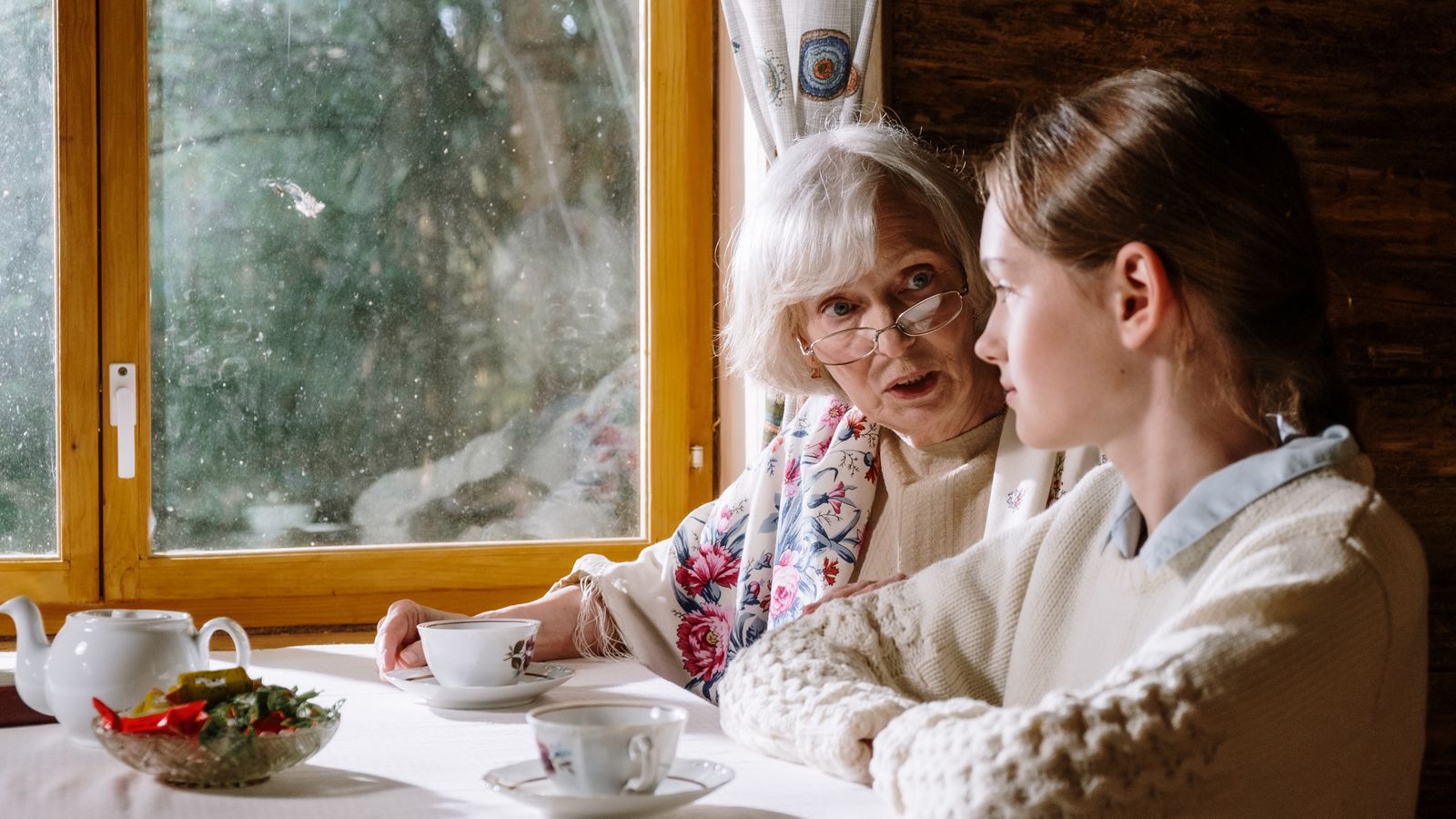
Say you run life enrichment at a 60-bed assisted living community. Your executive director came back from a conference convinced that "we need to be doing life stories." You agree. You have also been here before: the binder of "All About Me" forms from three directors ago is still on a shelf in the activity room, half of them blank.
That scenario is illustrative, but the binder is real in a lot of buildings. This guide is for the person who has to pick an approach and make it stick. It covers the main options, from free paper forms to software platforms, with what each one is genuinely good at. Porchlight is one of the options, and we will tell you where it fits and where it does not. The questions at the end are worth asking any vendor, including us.
First, decide what you need the stories for
"Life stories" can mean three different jobs, and most approaches are good at one or two:
- A keepsake for the family. Something the family can keep and hand down, ideally in the person's own voice.
- Knowledge for the care team. A short, usable picture of who someone is and how to approach them, available to whoever is on shift.
- Material for programs and community. Raw material for activities, a newsletter, and conversation between residents.
The research has a sharp warning about the second job. In the largest UK study of life story work, staff often never looked at the finished life stories, and the authors concluded that "Doing LSW is one thing; using it to inform and improve care is clearly another."1 Whatever you pick, judge it by whether the aide at 6 a.m. will actually see it.
Option 1: paper forms
One-page forms like the Alzheimer's Society's "This is me" in the UK, or the many US "All About Me" sheets, ask family or the resident to fill in background, important people, routines and preferences.2
Good at: cost (often free), speed, and the right length for staff. A one-pager is a better model for a staff tool than a book.
Weak at: they are written by someone else, usually once, and go stale. There is no voice and nothing for the family to keep. We found no published outcome evaluation of these forms; they are good practice, not proven practice.3
Option 2: your admission assessment
Nursing homes must assess life history and preferences, and MDS Section F asks residents how important things like music, bedtime and religious practice are.4 Many state assisted living rules ask for similar things at move-in; our state rules library has the details.
Good at: it already exists and surveyors look at it.
Weak at: it records that something matters, not the story behind it, and it lives in the record, where frontline staff rarely read narrative.
Option 3: staff-run interviews
An activity staff member sits with each resident over several sessions and writes or records their story.
Good at: it is the closest thing to what the research actually tested. Structured, one-to-one life review over several sessions has the strongest evidence for helping the teller.5
Weak at: time. Multiply several sessions by every resident, then by turnover, and it rarely survives a busy quarter.
Option 4: volunteers and students
Friendly-visitor programs, faith groups, high school and college students interview residents. Hospice volunteer programs do legacy projects for enrolled patients.
Good at: warmth and cost. A new face who has time to listen is a gift to many residents, and to the volunteers too.
Weak at: consistency. Programs follow the school calendar and volunteer availability, and they need privacy training and supervision.
Option 5: a personal historian
A professional interviews the person and produces a book or edited recording.
Good at: quality. The results can be beautiful.
Weak at: scale. It is priced per person, often in the hundreds of dollars or far more, which works for one family and not for sixty residents.
Option 6: consumer memoir services
Services like StoryWorth and Remento send a storyteller a prompt each week and turn the answers into a printed book. At the time of writing, StoryWorth listed plans at $69, $99 and $199, and Remento listed $99 for the first year including one book.6 Several newer services use AI phone interviews.
Good at: the family keepsake. They are well made, and a book is a lovely thing to hold.
Weak at: the care team. They are designed for a family gifting a parent, and their pricing pages describe no community offering. Many are email- or typing-first, which is hard for residents with low vision or tremor. Nothing reaches the staff.
Option 7: life story platforms for communities
A few products are built for senior living. The best established is LifeBio, whose LifeBio Memory app captures residents' stories by voice and produces a care snapshot and action plan for staff. Its published pricing is by census, from $79 a month for communities under 50 residents to $149 for 100 to 199.7 LifeBio describes itself as HIPAA compliant and has been funded through federal small business research grants. Two pre-post studies in Ohio nursing homes found small decreases in residents' depressive symptoms; they had no control group.8 Its own page says the self-run license suits communities with strong one-to-one engagement staff or reliable volunteers to do the recording, and it offers a paid service for those without.7 If you have the staff hours and want the most research behind you, it deserves a serious look.
Other tools touch life stories as part of a broader platform. StoriiCare, an activity and care platform, includes life story profiles that staff fill in. OneDay makes personalized videos, including resident stories, aimed largely at outreach and tours.9 Large engagement suites, such as LifeLoop (which acquired Linked Senior in 2024), cover calendars, content and family updates.10 If you already use one of these, check what it can do before adding anything new.
Where Porchlight fits
Porchlight is built for the communities that want all three jobs done and do not have the staff hours for interviews. A resident taps one button, hears a question read aloud, and talks; the tablet moves on after a story and a short pause. Questions are written by people, in a fixed order. Stories become a family page (listen, download, reply by voice note), a staff briefing with a door card and a first-shift card, and material for a community newsletter. Staff choose an early, middle or later stage for each resident, and family and staff can add stories for someone who can no longer tell them.
Where we are weaker, plainly: we are young and founder-led, we have no published outcome data, and we do not currently describe ourselves as HIPAA compliant or sign business associate agreements. If those are requirements for you today, that matters. We wrote a whole page on what Porchlight does not do.
Judge any approach by one test: will the aide at 6 a.m. actually see it?
Twelve questions to ask any vendor, including us
- Who does the interviews? How many staff minutes does it take to capture a resident's first five stories?
- What does a new or agency aide see, where, and how long does it take to read? Ask to see it on a phone.
- Can a resident with low vision, tremor or no email use it on their own?
- What happens in later-stage dementia? Does the tool keep asking questions into silence?
- Who chooses the questions? A person, or a model improvising? Can you see the whole bank?
- What does AI do with residents' words? Is the original audio kept? Can staff hear it?
- How do families get it, and can they keep their own copies? What happens to recordings if the vendor shuts down?
- Can families answer back?
- Who sees what, and how is consent recorded? Can a resident keep a story family-only?
- HIPAA: will they sign a BAA if you need one? Which outside services process the audio?
- Evidence: what studies exist, and did they have a control group?
- Price: flat or per resident? What does it cost at your census in year two?
A suggestion, whatever you choose
Start small and measure. Pick ten residents. Write down, before you start, how you will know it worked: staff minutes per resident, whether new staff saw the card before their first shift, whether families listened or replied, and a simple before-and-after rating from staff of how well they know each person. Every life story approach looks good in a brochure. The one that survives your Tuesdays is the right one.
Compare for yourself
The live demo shows the resident screen, the staff briefing and the family page with sample residents.
Explore a live demo Book a demoSources & notes
- Gridley K, Brooks J, Birks Y, Baxter K, Parker G. Improving care for people with dementia: development and initial feasibility study for evaluation of life story work in dementia care. Health Serv Deliv Res 2016;4(23). doi:10.3310/hsdr04230.
- Alzheimer's Society. "This is me." alzheimers.org.uk.
- Search of the peer-reviewed literature for this series found no published outcome evaluation of "This is me"; see also dementiapartnerships.com.
- 42 CFR 483.20(b)(1), eCFR ecfr.gov; CMS RAI 3.0 Manual, Section F PDF.
- Westerhof GJ, Slatman S. Meta-analysis of 11 randomized trials of life review therapy, n=903. Clin Psychol Sci Pract 2019;26(4):e12301. doi:10.1111/cpsp.12301.
- StoryWorth pricing storyworth.com; Remento pricing guide remento.co. Both accessed October 3, 2026.
- LifeBio licensing and pricing page, accessed October 3, 2026. lifebio.org.
- DiFranco et al. Two pre-post studies of LifeBio Memory in Ohio nursing homes (n=238 in 16 homes; n=107 in 11 homes). Innovation in Aging 2025. PMC.
- StoriiCare pricing and features storiicare.com; OneDay for senior living oneday.com. Both accessed October 3, 2026.
- Senior Housing News, "LifeLoop acquires Linked Senior," July 18, 2024. seniorhousingnews.com.
Scenarios marked as illustrative are not real named individuals. Porchlight does not fabricate customers, testimonials, or outcome metrics. Competitor prices and claims are as published on their own pages when checked on October 3, 2026, and may have changed.