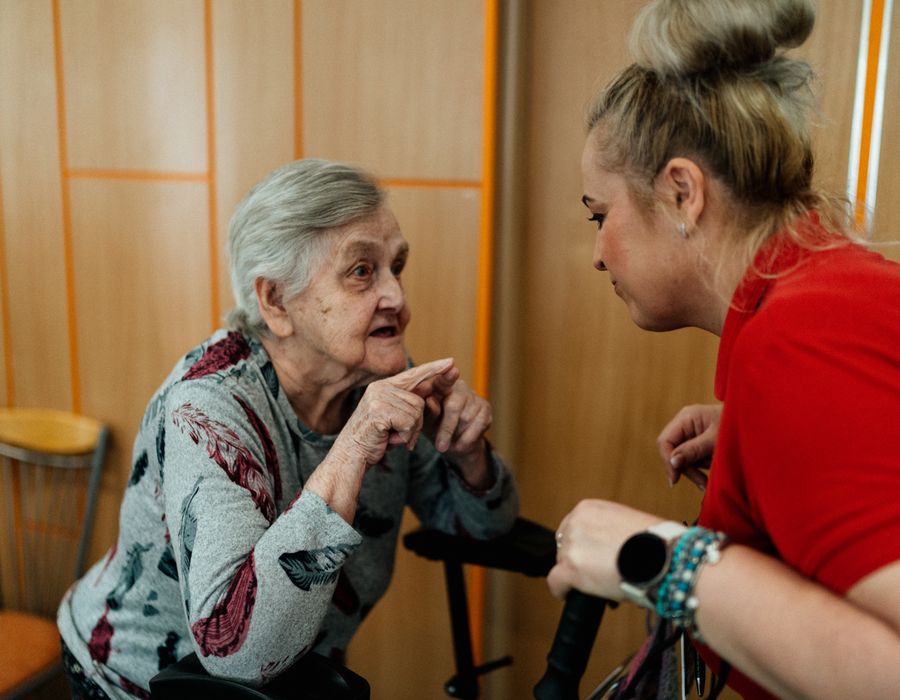
Picture a Tuesday at 6:40 in the morning. You have nine residents on your assignment and one of them, a man in room 14, does not want to get up. He swats at the blanket. He says your name wrong, or doesn't say it at all. You have eight other people waiting, a call light going down the hall, and a breakfast cart at 7:30.
Now picture the same morning, except that last night you read three lines on a card by his door. Goes by Walt. Thirty years as a lineman for the power company. Hates being rushed before coffee. You walk in and say, "Morning, Walt. Did you ever have to climb a pole in weather like this?" You bring the coffee first.
That scene is made up. The difference in it is not. Anyone who has done this work knows the gap between caring for a stranger and caring for someone you know a little. This piece is for you, the CNA, the aide, the resident assistant, the caregiver. You are the reason a life story is worth anything in a care community, and you are the person most often left out of the plan.
You spend more time with residents than anyone
There are roughly 708,000 nursing assistants working in nursing and residential care in the United States, and another 265,000 or so personal care aides working in assisted living and continuing-care communities. The median pay in nursing and residential care is about $42,000 a year for nursing assistants and about $37,000 for assisted living aides.1 In a certified nursing home, aides provide about 2.3 hours of care per resident per day, more than nurses and everyone else combined.2
Those hours are the most intimate in the building. You help people bathe, dress, use the toilet, turn in bed. On the Aging Well Podcast I tried to describe what that is like from both sides:
“When you enter the room as a caregiver, you know, with a new resident, let's say you've just joined the team... You might have to like empty their bedpan. You might have to turn them over to avoid bed sores... it's a difficult situation for both sides because the caregivers are rotating.”
Patrick Donahue, on The Aging Well Podcast
Nobody likes being handled by a stranger. Most of us put up with it at the doctor's office for ten minutes. Residents live with it every day, often with a new face on every other shift.
The stranger problem is real, and it is not your fault
Staff turnover in nursing homes is high enough that it barely sounds real. A study of payroll records from more than 15,000 nursing homes found average annual turnover among nursing staff of about 128 percent, with a median around 94 percent.3 In 2022 almost half of nursing homes used agency staff, and agency workers covered about 11 percent of direct-care nursing hours.4 Assisted living reports lower numbers, but turnover among resident assistants was still about 47 percent in one recent industry survey.5
Federal surveyors have noticed what that means for residents. In its guidance on physical restraints, the Centers for Medicare & Medicaid Services lists this as something surveyors should look for: staff who say that "new staff and/or temporary staff do not know the resident, how to approach, and/or how to address behavioral symptoms."6 In other words, the government's own inspectors name not knowing the resident as a root cause of harm.
If you have been the float aide on an unfamiliar hall, you know this from the inside. You are doing your best with no information. The fix is not for you to try harder. The fix is for the building to hand you what the last aide knew.
You are not there only to perform a task. You are there to make someone feel like a person while you do it.
What changes when you know one true thing
Researchers who study agitation in dementia have a useful way of thinking about it. A lot of what gets called "behavior" is a person trying to communicate a need they can no longer put into words. When Jiska Cohen-Mansfield and colleagues studied 89 agitated nursing home residents, they found each had about three unmet needs on average, and the most common were boredom, loneliness, and the need for something meaningful to do.7 You cannot meet those needs for someone you know nothing about. You can for someone you know was a lineman, a church organist, or a mother of six.
Studies of life story work, where a resident's history is collected and shared with staff, have a fairly consistent finding: the biggest change is in the staff. Aides who know residents' stories report more person-centered attitudes.8 In one experiment, 95 long-term care workers read about the same imaginary resident, either a standard medical description or the same description plus a short life story. The ones who read the life story felt more empathy, felt more confident about the care, saw the resident as less dependent, and even rated the workload as lighter.9 That was a reading exercise, not a real shift, so it shows a change in attitude rather than proof of better care. Still, it matches what aides say: knowing someone makes the work feel less like a list.
And in a German trial across 20 care facilities, staff who built small care plans from each resident's biography reported less time pressure and less job dissatisfaction than staff in comparison homes.10 Knowing people turned out to be good for the people doing the caring, too.
“That is the basis of what it means to be an effective caregiver. You're not just there to perform a task. It's also about how you make the other person feel.”
Patrick Donahue, on The Aging Well Podcast
Three lines worth knowing about everyone
You do not have time to read a life story book for every resident, and you should not have to. If the building gives you only three things about a person, ask for these:
- What they like to be called. Not the name on the chart. "Mrs. Albright," "Dot," "Doc," "Sister." Getting this right is the cheapest dignity there is.
- One thing they loved or were proud of. A job, a team, a place, a song, a dog. This is your conversation for the hard minutes, when you are helping with something neither of you wants to talk about.
- One thing that upsets them, or how they like their morning. Coffee before washing. The radio on. Never call her "honey." Don't mention his late wife at bedtime.
If you learn something new on a shift, say it at handoff or write it where the next person will see it. A detail that only lives in your head walks out the door when you change buildings. You are not just using the story. You are adding to it.
The family wants to hear what you know
Here is something families say again and again in research: they want to know about their person's ordinary days without having to ask. During the pandemic visiting bans, Swedish relatives told researchers they got general information from the home, but what they wanted was news about everyday life.11 You are the only one who has that news. "Your dad told me about climbing poles in an ice storm" means more to a daughter than any activity calendar.
That matters for you, too. Conflict with families is one of the things that wears aides down. A study of 655 nursing home nurses and aides found that family conflict was linked to more burnout and less job satisfaction.12 Families who feel their person is known tend to trust the people doing the caring. That does not fix short staffing, but it makes a hard job a little less lonely.
Where Porchlight fits in your day
I built Porchlight around one rule for aides: it should not add a single thing to chart. Here is what it actually does.
The resident tells the stories. They open a private link on a tablet or phone, tap one big button, and answer questions that are read aloud. The questions come in a fixed order that starts gentle, and they can skip any of them. Some days you might help someone get started, the way you would turn on a radio for them. That is it.
What you get back is short. Each resident has a Know-Your-Resident briefing with conversation starters, a printable door card, and a first-shift card written for someone who has never met them, which is exactly what an agency or float aide needs (more on that in your first shift with a new resident). If there are topics to avoid, they are on the profile. You can hear the resident's own voice telling a story if you want to, but you never have to sit through an hour of recordings to find the one useful line.
Families can also send voice notes back, and the resident can play them. Sometimes the best thing on a hard afternoon is a grandson's voice saying hello.
Porchlight does not diagnose anything, does not watch for distress, and does not decide anything about care. You do. It just tries to make sure you walk into room 14 knowing it's Walt.
Something you can do this week, with or without us
Pick one resident you care for who you know the least about. On one shift, while you are helping with something routine, ask one gentle question. "What did you do for work?" "Where did you grow up?" "What's a song you loved when you were young?" Use "tell me about" rather than "do you remember," which can feel like a test. Then tell the next shift what you learned.
That is the whole idea, at the size of one person. Everything else is just making it happen for every resident, on every shift, even after you have gone home.
Hand every aide the three lines that matter
See the door card, the first-shift card and a resident's briefing in the live demo.
Explore a live demo Talk to usSources & notes
- U.S. Bureau of Labor Statistics, Occupational Employment and Wage Statistics, May 2025, NAICS 623 (nursing and residential care facilities): nursing assistants 707,730 employed, median $42,050; home health and personal care aides in continuing care and assisted living (NAICS 6233) 265,100 employed, median $37,060. bls.gov/oes
- KFF, A Look at Nursing Facility Characteristics (2025): 3.85 total nursing hours per resident per day, of which aides 2.30. kff.org
- Gandhi A, Yu H, Grabowski DC. High nursing staff turnover in nursing homes offers important quality information. Health Affairs 2021;40(3):384-391. doi:10.1377/hlthaff.2020.00957
- Contract staff in nursing homes: Health Affairs 2024, doi:10.1377/hlthaff.2023.01101; ASPE issue brief, January 2025.
- HCS, LeadingAge and NCAL, 2023-24 Assisted Living Salary & Benefits Report (961 communities), as summarized by McKnight's Senior Living: resident assistant turnover 47.1%, CNAs 41.8%.
- Centers for Medicare & Medicaid Services, State Operations Manual Appendix PP, guidance to surveyors on physical restraints (Rev. 225, 2024). cms.gov
- Cohen-Mansfield J, et al. Which unmet needs contribute to behavior problems in persons with advanced dementia? Psychiatry Research 2015. doi:10.1016/j.psychres.2015.03.043
- Gridley K, Brooks J, Birks Y, Baxter K, Parker G. Improving care for people with dementia: development and initial feasibility study for evaluation of life story work in dementia care. Health Services and Delivery Research 2016;4(23). Staff person-centredness scores rose at first follow-up; the authors could not separate the effect from the training that came with it. doi:10.3310/hsdr04230
- Muller C, Missotten P, Adam S. The effect of a life story on care staff perceptions of a resident: a vignette study with 95 long-term care workers. Clinical Gerontologist 2020. doi:10.1080/07317115.2020.1845897
- Berendonk C, Kaspar R, Bär M, Hoben M. Improving quality of work life for care providers by fostering the emotional well-being of persons with dementia: a cluster-randomized trial (DEMIAN). Dementia 2019;18(4):1286-1309. doi:10.1177/1471301217698837
- Eriksson E, Hjelm K. Relatives' perspectives on encounters and communication in nursing homes during the Covid-19 pandemic: a qualitative interview study. BMC Geriatrics 2022. PubMed 36008775
- Abrahamson K, Suitor JJ, Pillemer K. Conflict between nursing home staff and residents' families. Journal of Aging and Health 2009;21(6):895-912. PubMed 19602705
Scenarios marked as illustrative are not real named individuals. Porchlight does not fabricate customers, testimonials, or outcome metrics. Podcast quotes are lightly trimmed of filler words; ellipses mark the cuts.