The short answer
- A reminiscence group is six to eight residents, a facilitator (plus a helper if you can), one theme with a tangible trigger, and 45 to 60 minutes, once a week for at least eight weeks.
- Group format is where the dementia evidence for communication is clearest: the Cochrane review found a probable slight benefit on communication for group reminiscence, and NICE says to "consider" it for mild to moderate dementia.12
- Eight weeks has a reason behind it: in older adults without dementia, two meta-analyses found programs of eight weeks or more improved life satisfaction more than shorter ones.34
- Invite, never quiz: "Tell me about..." instead of "Do you remember...?"6
- Keep family involvement optional. Joint resident-and-carer groups in the REMCARE trial did not improve quality of life, and carers reported more anxiety.5
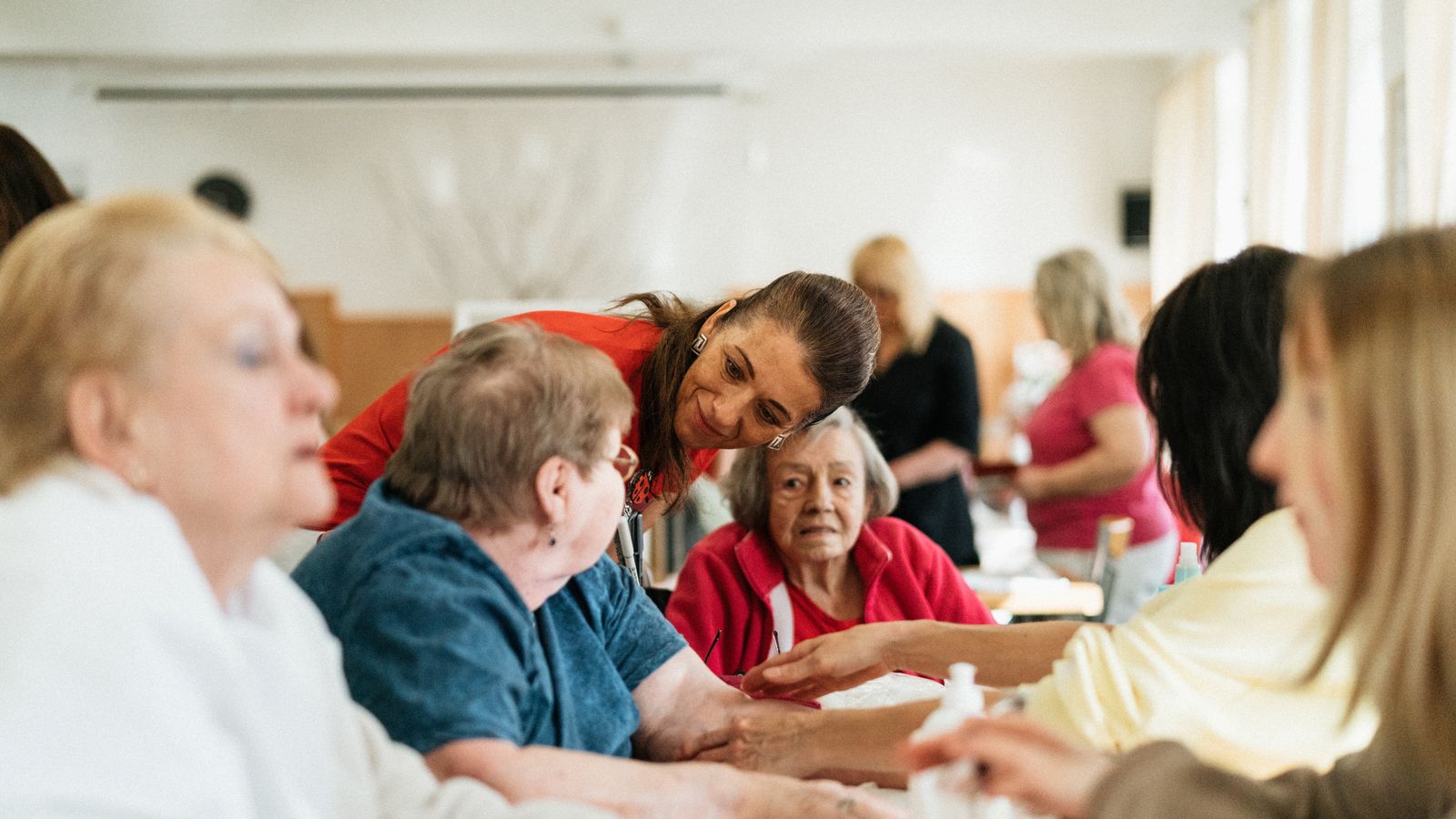
A good reminiscence group looks effortless from the doorway: a table of people laughing about school lunches, someone passing around a photo, a quiet resident suddenly telling the story of her first job. It rests on a structure most people never see, from who sits where to how the first question is worded. This guide lays that structure out as an 8-week plan you can run as written or adapt.
For the background on what reminiscence therapy is and where the evidence stands, start with our complete guide to reminiscence therapy. For individual ideas you can slot into any week, see 40 reminiscence therapy activities, and for wording, 120 reminiscence questions for seniors.
What the research says about group reminiscence
- Communication is the clearest group benefit. The 2018 Cochrane review (22 trials, 1,972 people with dementia) found a probable slight benefit on communication for group reminiscence. Overall effects were "inconsistent, often small in size," and group formats showed little or no difference on cognition. Individual reminiscence, not group, was the format linked to a slight benefit on mood.2
- Guidance is supportive but measured. NICE recommends: "Consider group reminiscence therapy for people living with mild to moderate dementia." "Consider" is a weaker word than the "offer" NICE uses for group cognitive stimulation therapy.1
- Loneliness is promising, not proven. A 2025 meta-analysis found group formats reduced loneliness more than individual ones, and professional facilitators did better than non-professionals.7 But a 2026 review of group reminiscence in nursing homes found no significant effect on loneliness.8
- Duration matters. In older adults without obvious cognitive impairment, programs of eight weeks or more improved life satisfaction more than shorter ones.34
- Joint family groups disappointed. REMCARE randomized 487 people with mild to moderate dementia and their family carers to 12 weekly joint groups plus monthly follow-ups, or usual care. There were no differences on primary or secondary outcomes; carers in the reminiscence arm reported more anxiety, and carers who attended more reported more caregiving stress.5 A second trial of the same joint format found no effect on quality of life, though carers reported better relationship quality.9 In interviews, carers described losing their respite and feeling added stress and guilt.10
- People are the active ingredient. In a trial in residential care homes, structured memory sessions and unstructured volunteer visits improved depressive symptoms, anxiety and loneliness equally.11 Warm, consistent human attention does a lot of the work.
The plain summary: run your group for connection, conversation and enjoyment. Don't advertise it as a treatment for dementia or memory loss, because the evidence doesn't support that.
Who to invite, and how many
Six to eight residents. That's large enough for stories to spark off each other and small enough that everyone gets a real turn in 45 minutes and the facilitator can see every face. This number is practice consensus rather than a trial finding; REMCARE ran groups of up to 12 resident-carer pairs, but with two trained facilitators and volunteers.5
- Keep it a closed group. The same members for all eight weeks builds trust. Add newcomers only at the start of a new cycle.
- Group by ability, roughly. People with mild impairment and people with moderate dementia need different pacing. Two smaller, better-matched groups beat one mixed group that frustrates both.
- Invite, and accept a no. Ask each person individually and explain what happens. For nursing homes, federal rules require support for residents' "choice of activities."12 A resident who declines this week can be asked again next week.
- Check histories first. Talk with social services or nursing about recent bereavements and known trauma. A group is not the place to work through combat, abuse or displacement; that belongs with clinicians. Our guide to handling distress in reminiscence sessions goes deeper.
Room setup
- One table, chairs in a circle or horseshoe, nobody with their back to the facilitator. A table small enough to pass objects across.
- A quiet room with the door closed and the TV off. Light on faces, not behind them.
- Hearing aids in and working. Seat residents who are hard of hearing on the facilitator's better side.
- Large-print name cards, printed on both sides so neighbors can read them too.
- Trigger materials on a side table, brought out one at a time.
- Water and tissues within reach but not on display.
- Same room, same day, same time, same facilitator every week.
The anatomy of a 45-to-60-minute session
Published community reminiscence programs mostly ran fewer than ten sessions of about 60 minutes.13 For residents with dementia, CMS surveyor guidance favors activities that are "short and repetitive, and that are stopped if the resident becomes overwhelmed."12 With a moderate-dementia group, trim the main round and aim nearer 30 to 40 minutes.
| Segment | Minutes | What happens | Sample line |
|---|---|---|---|
| Welcome | 5-10 | Greet each person by name; name the theme. | "It's good to see you, Ruth. Today we're talking about the places we grew up." |
| Warm-up | 5 | Pass one object or smell around the circle. | "Have a hold of this. What does it make you think of?" |
| Main round | 25-30 | Bring out the trigger; open invitations; link stories between members. Offer turns, never force them. | "Walter, you grew up near water too. What was your river like?" |
| Wind-down | 5-10 | A lighter, reflective question that brings the group toward the present. | "If a youngster asked what was best about growing up where you did, what would you tell them?" |
| Close | 5 | Thank each person by name, echo one thing they said, preview next week. | "Thank you, Ruth, for the bakery story. Next week: school days." |
| After | 10 | Facilitator writes short notes for the care plan (see below). |
Reminiscence group activities, week by week
The plan moves roughly forward through a life, from childhood to the present, and closes on what members would pass on. Week 1 starts with hometowns because "hometown" was the most common theme in the community programs Shin and colleagues reviewed, and because it's an easy, low-risk way in.13
| Week | Theme | Trigger on the table | Opening invitation |
|---|---|---|---|
| 1 | Where we grew up | Wall map and pins, vintage postcards | "Tell me about the street you grew up on." |
| 2 | School days | A slate or chalk, a lunch pail, era classroom photos | "What was the walk to school like?" |
| 3 | Play and pastimes | Jacks, marbles, a jump rope, a baseball glove | "What did kids do on a summer evening where you lived?" |
| 4 | Kitchens and family food | Smell jars, recipe cards, an old mixing bowl | "What was cooking when you walked in the door?" |
| 5 | Work and first jobs | Tools of members' trades, a uniform, an old pay envelope | "Tell me about your first job. How did you land it?" |
| 6 | Music and going out | Songs from members' teens and twenties, dance hall photos | "Where did people go on a Saturday night?" |
| 7 | Homes we made | House keys, photos of homes, a doormat or porch light | "Tell me about a place that felt like home when you were grown." |
| 8 | What we'd pass on | A "recipe for a good life" card per person; a small celebration | "What's one thing you learned that you'd want a young person to know?" |
A few notes on the themes. Week 7 is worded as "homes we made," not "marriage and children," because not everyone married, had children, or had a happy family home, and a group opener shouldn't assume they did. If food is tasted in week 4, check diet orders and swallowing precautions with nursing first. Week 8 leans on meaning on purpose: in an early study of reminiscence types, older adults who were aging well did more reminiscing that made sense of their lives and drew on past coping.14 With permission, collect one line from each member into a printed keepsake.
Themes to avoid as openers: war, the hardships of the Depression, lost children, forced moves. They may come up anyway, and when they do you listen and support. You just don't put them on the agenda.
Facilitator lines that invite rather than quiz
The Alzheimer's Association sums up the whole craft in one sentence: "The goal is connection, not testing memory."6 Nearly every quiz question has an inviting twin.
| Instead of (a test) | Try (an invitation) |
|---|---|
| "Do you remember your first job?" | "Tell me about your first job." |
| "Who's this in the picture?" | "Tell me about the people in this picture." |
| "What was the name of your street?" | "What did your street look like?" |
| "No, that was 1952, not 1948." | "That sounds like it was a big year for you." |
| "You told us that last week." | "I love that story. What happened next?" |
| "Come on, you must remember." | "Take your time. Or we can come back to it." |
Keep a few linking and reflecting lines in your pocket: "Did anyone else have a job like that?" "That sounds like it took courage." "How did that feel?" "What did your mother say?" They turn a round of separate answers into a conversation between members, which is where the group format earns its keep.
Handling the three hardest moments
The dominant talker
Every group has one, and they're usually carrying the energy you need. Acknowledge, then bridge: "Frank, that's a great story. I want to hear how the others got to school. Mary, was yours a long walk?" Seat them beside you so a light touch on the arm can mark a pause. If it keeps happening, talk with them privately and offer a one-to-one session where they can talk as long as they like.
The silent member
Silence is not the same as disengagement. Watch for nods, smiles and leaning in. Hand them the object rather than the question. Offer an easy choice ("City or country for you, Helen?") instead of an open prompt, and never put them on the spot twice. Check hearing and seating before anything else. Then follow up one-to-one: some people have plenty to say but not in front of eight others.
Tears
Pause. Name it gently: "That's a hard memory. Thank you for telling us." Don't rush to fix it or change the subject in the same breath. The Alzheimer's Society advises that the person "should be supported to express their feelings and to address the memory if they are comfortable doing so."15 Offer a tissue quietly and ask whether they'd like to keep talking, take a moment, or step out with your helper. Before the session ends, bring the group to a lighter place so no one leaves on the sad note, and tell the care team afterward.
Escalate the same day to nursing or social work if anyone expresses a wish to die, discloses abuse (which may trigger mandatory reporting), or stays distressed after the session. That's practice consensus, and it matters more than any theme.
Documenting into the care plan
The ten minutes after the session are where group reminiscence starts paying off across every shift. Write one short note per member:
- Attendance and engagement. Present, how long, and a simple rating (engaged, watched, withdrawn).
- Identity anchors. Names, places, jobs, faith, songs: "Grew up on a dairy farm in Wisconsin; brother Leo; loves Patsy Cline."
- What lit them up. Topics that brought energy or calm, for staff to use during care.
- Handle gently. Only what the resident showed or said, in their words: "Became tearful talking about her son; comforted; changed topic."
- Follow-up. Referrals, a one-to-one visit, a note to family if the resident agreed.
For nursing homes, federal rules require activities to be based on the comprehensive assessment, the care plan and each resident's preferences, and surveyor guidance points to "the resident's lifelong interests, spirituality, life roles" as assessment sources.12 Assisted living is regulated by each state, so check your state's service-plan rules, but the same notes serve both.
Two cautions. First, what's said in the group is not automatically for sharing: researchers of life story work found private memories surfacing that were not meant for any written record, and warned "You have to be mindful of whose story it is."16 Ask before anything goes to family or onto a bulletin board. Second, if you want to know whether the group helps, measure it: attendance plus a brief tool such as the 3-item loneliness scale or an observed engagement measure, before and after the eight weeks.1718 Be cautious with before-and-after gains that have no comparison group; that design is a common reason this field overstates its results.
Should families join?
Make it optional, and make it light. The joint-group trials above are the reason: no gain in quality of life for the person with dementia, and more anxiety and stress for carers who attended.510 Families can help in ways that don't cost them their respite: send photos and facts before the relevant week, come to the week 8 celebration if the resident wants them there, or receive the keepsake afterward. Life story books made by relatives have been linked to better relationship quality with the resident. Giving families something to make and keep may serve them better than another meeting to attend.19
Where Porchlight fits
Porchlight doesn't generate themes or circle plans; the eight weeks above are yours to run. What it includes is a printable "story session" run-of-show for small groups, in which each resident records their own stories using a QR card while staff act as a warm audience. That's a different format from a discussion circle. Everyone records individually, side by side, so it can sit alongside your weekly group: for residents who would rather talk one-to-one than in front of eight people, or as a way to capture the stories your circle surfaced. Family members can add their own questions and photos that become prompts, and staff get a "Know Your Resident" briefing with conversation starters that can help you prepare links between members before week 1.
It's a tool that lowers the labor of individual, consistent reminiscence. The facilitator in the circle is still the point.
Frequently asked questions
How many people should be in a reminiscence group?
Six to eight residents is a practical size for a 45 to 60 minute session: everyone can get a real turn and the facilitator can see every face. This is practice consensus rather than a trial finding. Published trials have used larger groups, but with two trained facilitators and volunteers.
How long should a reminiscence session last?
Plan for 45 to 60 minutes, including the welcome and close. Published community programs typically ran about an hour. For people with moderate dementia, 30 to 40 minutes often works better, and any session should stop if someone becomes overwhelmed.
How often should a reminiscence group meet?
Weekly, for at least eight weeks. In older adults without dementia, two meta-analyses found programs lasting eight weeks or more improved life satisfaction more than shorter ones. Keeping the same day, time, room and facilitator helps members settle in.
What do you talk about in a reminiscence group?
Choose one theme per session and bring a tangible trigger for it: hometowns with a map, school days with era photos, food with smell jars, work with tools of the trade, music with songs from members' teens and twenties. Open each theme with an invitation such as "Tell me about..." rather than a memory quiz.
Should family members attend reminiscence groups?
Make it optional. In the REMCARE trial, joint groups for people with dementia and their family carers did not improve quality of life, and carers reported more anxiety. Families can contribute photos and facts beforehand or join a single celebration session without being asked to attend every week.
Is group reminiscence therapy effective for dementia?
Modestly. The Cochrane review found a probable slight benefit on communication for group reminiscence, but overall effects were small and inconsistent, with little effect on cognition for group formats. NICE says to consider group reminiscence for people with mild to moderate dementia. Run it for connection and conversation, not as a treatment.
Pair your circle with one-to-one stories
See the printable story-session run-of-show, the one-button resident app, and the staff briefing in a live demo.
Explore a live demo Book a demoSources & notes
- NICE (2018). Dementia: assessment, management and support for people living with dementia and their carers (NG97), recommendations 1.4.2-1.4.3. https://www.nice.org.uk/guidance/ng97/chapter/Recommendations
- Woods B, O'Philbin L, Farrell EM, Spector AE, Orrell M (2018). Reminiscence therapy for dementia. Cochrane Database of Systematic Reviews 3:CD001120. PMID 29493789. doi:10.1002/14651858.CD001120.pub3
- Xu L, Li S, Yan R, Ni Y, Wang Y, Li Y (2023). Effects of reminiscence therapy on psychological outcome among older adults without obvious cognitive impairment: a systematic review and meta-analysis. Front Psychiatry 14:1139700. PMID 37065888. doi:10.3389/fpsyt.2023.1139700
- Lin CL, Arifin H, Janitra FE, Aini N, Jiang P, Han HM, Hsu WC (2026). Comparative effectiveness of reminiscence-based therapies on depressive symptoms and life satisfaction in older adults: a network meta-analysis of randomised controlled trials. Age Ageing 55(3):afag075. PMID 41934513. doi:10.1093/ageing/afag075
- Woods RT, Orrell M, Bruce E, Edwards RT, Hoare Z, Hounsome B, et al. (2016). REMCARE: pragmatic multi-centre randomised trial of reminiscence groups for people with dementia and their family carers: effectiveness and economic analysis. PLoS One 11(4):e0152843. PMID 27093052. doi:10.1371/journal.pone.0152843. Full report: Woods RT, et al. (2012). Health Technol Assess 16(48). PMID 23211271. doi:10.3310/hta16480
- Alzheimer's Association (US). Reminiscence and reminiscence therapy. https://www.alz.org/help-support/caregiving/daily-care/reminiscence-and-reminiscence-therapy (accessed September 2026). Practice guidance.
- Yang H, Zhong Q, Han B, Pu Y, He R, Huang K, et al. (2025). Effects of reminiscence therapy for loneliness in older adults: a systematic review and meta-analysis. Age Ageing 54(5):afaf136. PMID 40434177. doi:10.1093/ageing/afaf136. An erratum was published: Age Ageing 2026;55(6):afag196, PMID 42359778, doi:10.1093/ageing/afag196.
- Li S, Chong MC, Che CC, Zhang X, Li L, Deng J (2026). Effects of group reminiscence on psychosocial outcomes among nursing home residents with intact cognition and mild cognitive impairment: a systematic review and meta-analysis. Int J Nurs Sci 13(4):371-379. PMID 42521387. doi:10.1016/j.ijnss.2026.06.010
- Charlesworth G, Burnell K, Crellin N, Hoare Z, Hoe J, Knapp M, et al. (2016). Peer support and reminiscence therapy for people with dementia and their family carers: a factorial pragmatic randomised trial. J Neurol Neurosurg Psychiatry 87(11):1218-1228. PMID 27521377. doi:10.1136/jnnp-2016-313736
- Melunsky N, Crellin N, Dudzinski E, Orrell M, Wenborn J, Poland F, et al. (2015). The experience of family carers attending a joint reminiscence group with people with dementia: a thematic analysis. Dementia (London) 14(6):842-59. PMID 24381218. doi:10.1177/1471301213516332
- Westerhof GJ, Korte J, Eshuis S, Bohlmeijer ET (2018). Precious memories: a randomized controlled trial on the effects of an autobiographical memory intervention delivered by trained volunteers in residential care homes. Aging Ment Health 22(11):1494-1501. PMID 28929782. doi:10.1080/13607863.2017.1376311
- 42 CFR § 483.24(c), Activities (F679), and CMS State Operations Manual Appendix PP, Guidance to Surveyors for Long Term Care Facilities (Rev. 225, 08-08-24). These requirements apply to Medicare/Medicaid nursing homes (SNF/NF); assisted living is regulated by the states.
- Shin E, Kim M, Kim S, Sok S (2023). Effects of reminiscence therapy on quality of life and life satisfaction of the elderly in the community: a systematic review. BMC Geriatrics 23(1):420. PMID 37430198. doi:10.1186/s12877-023-04001-1
- Wong PT, Watt LM (1991). What types of reminiscence are associated with successful aging? Psychology and Aging 6(2):272-9. PMID 1863396. doi:10.1037//0882-7974.6.2.272
- Alzheimer's Society (UK). Therapy and approaches for memory loss support: life story work and reminiscence work. https://www.alzheimers.org.uk/about-dementia/stages-and-symptoms/dementia-symptoms/approaches-therapy-memory-loss (accessed September 2026). Practice guidance.
- McKeown J, Ryan T, Ingleton C, Clarke A (2015). 'You have to be mindful of whose story it is': the challenges of undertaking life story work with people with dementia and their family carers. Dementia (London) 14(2):238-56. PMID 24339102. doi:10.1177/1471301213495864
- Hughes ME, Waite LJ, Hawkley LC, Cacioppo JT (2004). A short scale for measuring loneliness in large surveys: results from two population-based studies. Res Aging 26(6):655-672. PMID 18504506. doi:10.1177/0164027504268574
- Cohen-Mansfield J, Hai T, Comishen M (2017). Group engagement in persons with dementia: the concept and its measurement. Psychiatry Res 251:237-243. PMID 28214783. doi:10.1016/j.psychres.2017.02.013
- Subramaniam P, Woods B, Whitaker C (2014). Life review and life story books for people with mild to moderate dementia: a randomised controlled trial. Aging Ment Health 18(3):363-75. PMID 24063317. doi:10.1080/13607863.2013.837144
The group size, room setup, session timings, themes and facilitator scripts in this guide are practice consensus, not tested as a package in a trial. Porchlight is a conversation and life-story tool, not a medical device or a clinical treatment. This article is educational and is not medical advice. No fabricated customers, testimonials, or outcome metrics appear here.