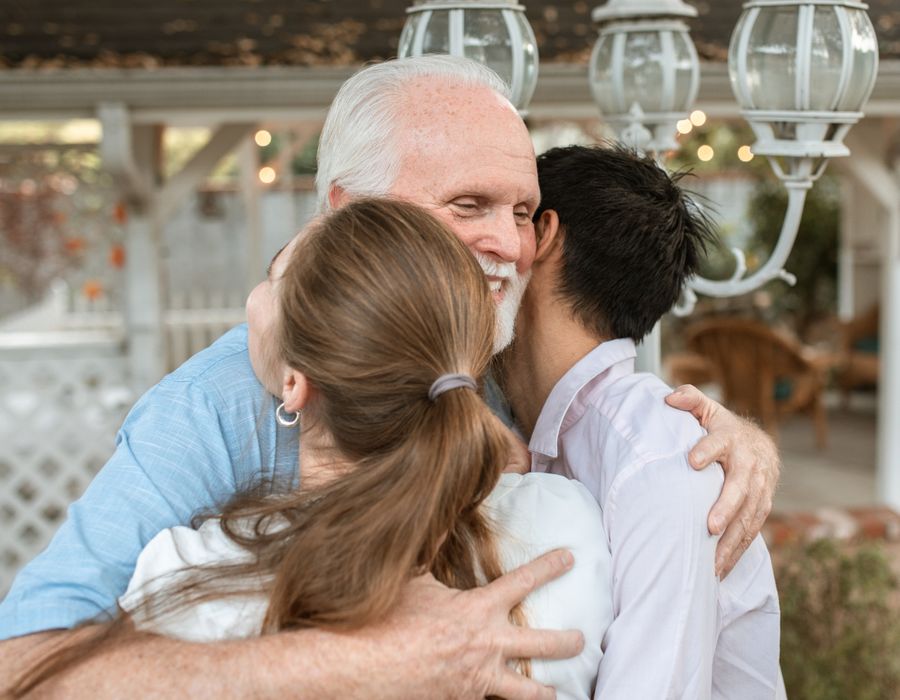
Picture a fourteen-year-old on a long car ride, earbuds in, staring at fields. Her grandfather, in the passenger seat, starts telling her dad about the winter the family's furnace died and everyone slept in the kitchen. She pulls one earbud out. Then the other. "Wait, you slept on the floor?"
That's the moment this piece is about. Not a book on a shelf. A kid finding out her family went through things, and got through them.
The "Do You Know?" scale
Around 2000, the psychologist Marshall Duke and his colleague Robyn Fivush at Emory University started asking children twenty simple questions. Do you know where your grandparents grew up? Do you know where your parents met? Do you know about an illness or something really terrible that happened in your family? Do you know what went on when you were born?
They found that children who knew more of the answers tended to have a stronger sense of control over their lives, higher self-esteem, better family functioning, less anxiety and fewer behavior problems.1 A follow-up with teenagers found that knowing more family stories went with higher emotional well-being and a firmer sense of identity, even after accounting for how well the family functioned.2 Bruce Feiler popularized the work in a 2013 New York Times column that's been shared ever since.
The catch: this is correlation
Here is what the column usually skips. These studies show that knowing family stories goes with doing well. They don't show that memorizing family history causes it. The samples were small. The likeliest explanation, and the researchers say as much, is that kids who know a lot of family stories come from families that talk a lot: around the table, in the car, at bedtime. The stories mark a family that spends time together.
So if you print a family tree and make your kids study it, don't expect a miracle. The finding points somewhere more useful.
The stories mark a family that talks. The talking is the point.
What actually seems to matter: telling it together
Fivush's group also recorded families telling stories about shared experiences, like a vacation or a rough day. When families told stories in a coordinated way, with everyone chiming in and different views woven together, children had higher self-esteem. When one person dominated and imposed their version, that link wasn't there.3
That points to the kind of story worth telling a child. Not a highlight reel, and not a list of disasters, but the real thing: what was hard, who helped, and how the family got through it. A grandparent is often the only person who can tell those stories from the inside.
Grandparents hold the oldest chapters
Parents can tell kids about their own childhoods. Only grandparents, and great-grandparents if you're lucky, hold the chapters before that. The farm. The immigration. The war. The first person in the family to go to college. When those people are gone, the chapters usually go with them.
Most adults already feel that gap. In a British survey, only two in ten people knew how their grandparents met.4 That poll was commissioned by a life-story charity, so treat the figure as a rough guide. Ask yourself the same question, though, and see how you do.
Which stories to tell a child, and when
Not every family story is right for every age. A seven-year-old wants the funny ones: the cow that got loose, the time Grandpa drove the wrong way for a hundred miles. A twelve-year-old can handle the stories about being poor, being new in a country, or being bullied. A teenager is often ready for the real chapters, the divorce or the illness or the year everything fell apart, and is usually more interested in those than adults expect.
The common thread is honesty with a way through. Kids don't need to be shielded from the fact that their family had hard times. What they seem to need is to hear that people they love came through those times, with help from each other. That is a story a kid can borrow when their own year goes badly.
It also helps to let the grandparent be human. A grandmother admitting she was terrible at school, or a grandfather confessing he was scared on his first day of work, gives a kid permission to be imperfect too. Those little admissions are often the stories that get retold at the grandparent's funeral, by the grandchildren, decades later.
Five ways to get grandparents and kids telling stories together
- Give the kid the questions. A teenager interviewing a grandparent is a different conversation than a parent doing it. Hand them three questions and a phone.
- Ask about hard times and how they got through. "What was the hardest year?" and "Who helped?" make exactly the ups-and-downs story the research describes.
- Let everyone add their version. "That's not how Grandma tells it" is a feature. Coordinated storytelling is the kind linked to kids doing well.
- Make it a routine, not an event. One story at Sunday dinner beats one big recording session at Thanksgiving.
- Keep the voice. Record it. In twenty years your kid will want to hear it, not read a summary.
Our printable holiday table questions work well for this, and our letter to grandchildren is written for the kids themselves.
What to do if your kids roll their eyes
They will, at first. Family history sounds like homework. A few things help. Let the kid pick the question. Make it about something they already care about: what music Grandpa listened to at their age, what Grandma got in trouble for, what a first car cost. Keep it short; ten minutes is a win. And let them record it on their own phone, so it's theirs.
You are not trying to produce a documentary. You are trying to create one moment where a kid realizes the old person across the table was once their age, scared and broke and in love and making mistakes. That realization is the thing. Everything the research hints at seems to grow from it.
It works in the other direction too. Grandparents often don't know much about their grandkids' lives beyond school and sports. When stories go both ways, with a teen explaining a game or a band and a grandparent explaining the Depression or the draft, it stops being an interview and becomes a relationship. That two-way, everyone-adds-something kind of storytelling is the kind the research ties to kids doing well.3
When distance gets in the way
The research assumes families who see each other. Plenty don't. Grandparents live in another state or in a senior community across the country, and visits happen twice a year. Then the stories need a way to travel.
That's one of the reasons Porchlight works the way it does. A grandparent records a story by answering a question read aloud on a tablet. The family hears it on a private page, and anyone, including a grandkid, can reply with a voice note that the grandparent plays back. Families can suggest the questions they want asked. It isn't the same as the kitchen table. It does keep the conversation going between visits, and it means the story about sleeping on the kitchen floor gets told in his voice, to her, even if they're two thousand miles apart.
The honest claim is modest: nobody has studied whether a family audio page makes kids more resilient, and I won't pretend otherwise. What the research does support is that families who tell their stories together, ups and downs included, tend to raise kids who feel part of something. Anything that gets more of those stories told is worth trying.
Keep the oldest chapters in the family
See how a grandparent's recorded stories reach the whole family, and how a grandkid can answer with a voice note.
Explore a live demo Book a demoSources & notes
- Duke MP, Lazarus A, Fivush R. Knowledge of family history as a clinically useful index of psychological well-being and prognosis: a brief report. Psychotherapy (Chic). 2008;45(2):268-72. The 20-item "Do You Know?" scale. PubMed 22122420
- Fivush R, Bohanek JG, Zaman W. Personal and intergenerational narratives in relation to adolescents' well-being. New Dir Child Adolesc Dev. 2011;(131):45-57. PubMed 21387531
- Bohanek JG, Marin KA, Fivush R, Duke MP. Family narrative interaction and children's sense of self. Fam Process. 2006;45(1):39-54. Coordinated family storytelling, where everyone's perspective is woven in, went with higher self-esteem. PubMed 16615252
- Augr survey of 2,000 British adults, April 2021 (commissioned by a life-story nonprofit, so treat as directional). Press release
Scenarios marked as illustrative are not real named individuals. Porchlight does not fabricate customers, testimonials, or outcome metrics. Podcast quotes are lightly trimmed of filler words; ellipses mark the cuts.