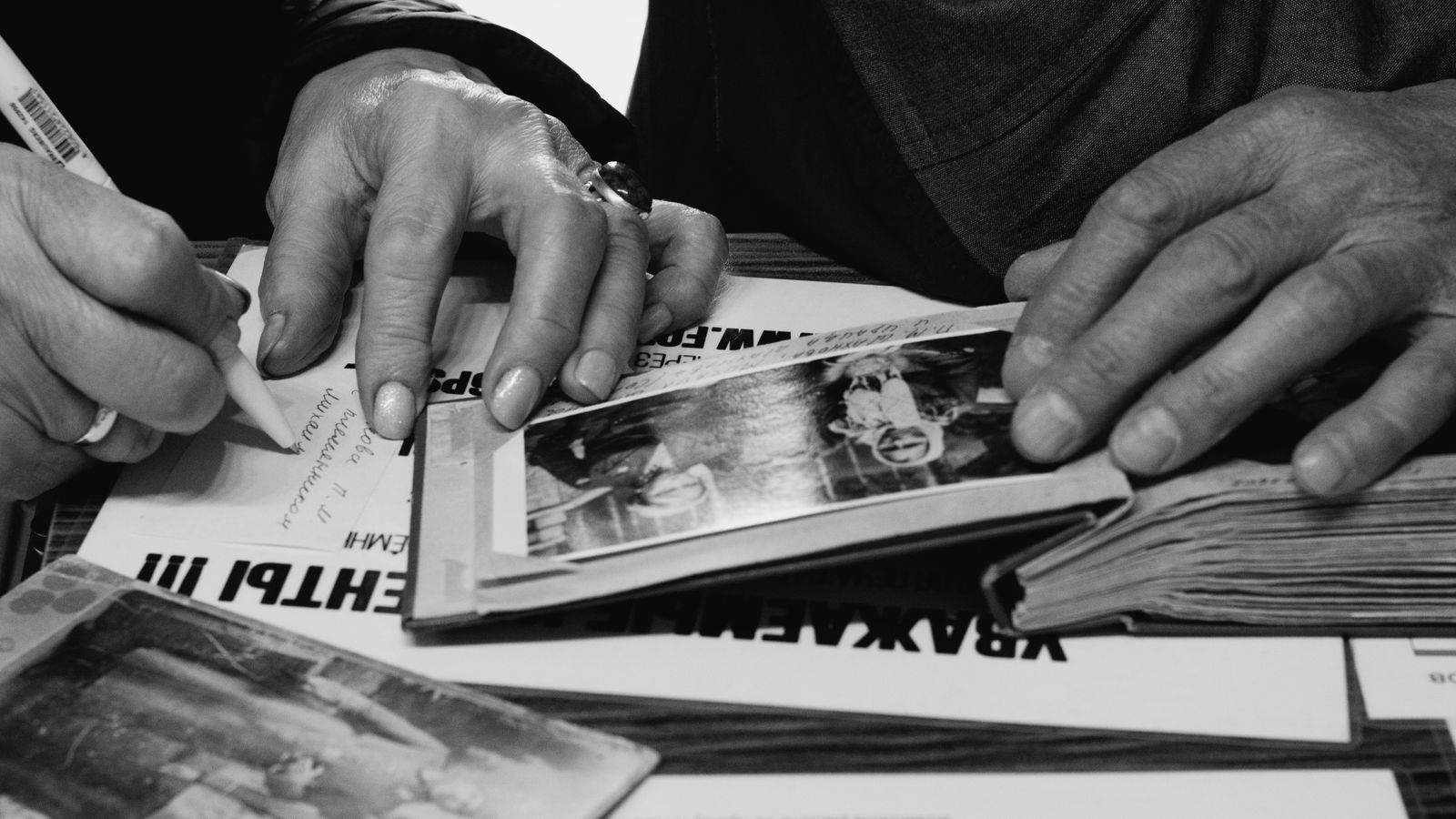
Somewhere in your building, there is probably a beautiful life story that nobody reads. Picture it, as an illustration: a daughter spent three weekends on it. Photographs of her mother's wedding, the dairy farm in Wisconsin, the forty years of choir. She laminated the pages. She handed it to the nurse on move-in day, who thanked her warmly and filed it in the chart. Eighteen months later, the night aide who helps her mother to the bathroom at 3 a.m. has never seen it, and does not know it exists.
Nobody in that story did anything wrong. That is what makes it worth understanding. The book was made with love, accepted with sincerity, and stored in the sensible place. It just never reached the person at the door. This happens so often that researchers have a name for the gap between making life stories and using them.
What the biggest study found
The most thorough look at this question is a UK study funded by the National Institute for Health Research and published in 2016. Kate Gridley and colleagues surveyed hundreds of care providers, surveyed family carers, and ran a feasibility trial in six care homes and several hospital wards.1 What they found is worth quoting directly:
"The day-to-day use of the life story product was not as high as might be hoped. Doing LSW is one thing; using it to inform and improve care is clearly another."
The details are sobering.
- When family carers were asked how often care staff looked at their relative's life story, 7 said weekly, 3 monthly, 6 less than monthly, 7 never, and 10 did not know.1
- Only 24% of services said all staff could look at a resident's life story. Not one generalist long-term care home chose "any staff can look."1
- The most common place to keep the story was the care record, at 61%.1
- Only 28% kept the story "dynamic," adding recent events. Permission was formally recorded in only 15%.1
Staff attitudes toward dementia did improve after life story work began, at least at first. But the authors could not separate that from the training that came with it, and they did not find a clear quality-of-life gain for most residents.1
It is not just one study, and it is not just the UK
Germany requires life story work in nursing homes. Researchers there found it was still "not implemented successfully," with staff holding very different ideas of what it was for, and some unsure whether it did anything for residents at all.2 In Sweden, a 2024 analysis of 30 life story templates found that the mere existence of a life story can count as a quality marker in national comparisons, whether or not anyone uses it.3 A Danish study of a digital life story app found time and IT problems limited its use, and visible management support mattered.4
The pattern is consistent across countries. Existence is not use.
The question is never "do we have their story?" It is "who read it this week?"
Six reasons the binder stays shut
Read across the research and talk to anyone who has worked a hallway, and the reasons are not mysterious.
- It is in the wrong place. A chart, a shared drive, a binder in the nurse's station. The aide works in the resident's room and the hallway, not in the record.
- It is the wrong length. A 20-page book is a gift for the family. On shift, a staff member has seconds. In US nursing homes, aide time averages a little over two hours per resident per day for all care combined.5
- It is narrative, not practical. A lovely chapter on the farm does not tell you how to get through a shower. Staff need "what to do," and the story has to be translated into that.
- New people never hear about it. With nursing home staff turnover around 94% at the median by one measure, the person who received the book on move-in day may be long gone.6
- It goes stale. Written once at admission, never updated. People change, and a story that freezes someone at 70 can mislead the staff caring for them at 90. Gridley's focus groups worried about residents being "set in stone."1
- Nobody owns it. Without a named champion and some leadership support, it becomes one more document. Reviews of implementation keep landing on the same conclusion: it takes education, time, resources and management commitment.7
What makes a life story get used
The research also points to the fixes. None of them are expensive. Most are about design.
- Readable in under a minute. The UK Alzheimer's Society's "This is me" leaflet is a good model: one page, standard headings, travels with the person.8
- At the point of care. On the door, at the shift huddle, on the device staff already carry. Not in a chart.
- Visible to everyone who walks in, including agency staff, with the resident's or family's permission and with private details kept out of the staff version.
- Action first. Name, approach, comforts, triggers, one thing to talk about. The story behind it can sit underneath.
- Present as well as past. Dated, updated, with room for "this no longer works." Current preferences always win over old ones.
- Owned. One person in the building checks that new residents have one and new staff have seen them.
If you have a stack of beautiful life story books right now, you do not have to start over. Take each one and pull out five lines for a door card. That afternoon of work may do more good than the books have done so far.
A ten-minute audit you can run this week
If you lead a team, try this. Pick three residents at random. Then walk the floor and ask three staff members, including someone new and someone on a later shift, the same five questions about each resident:
- What do they like to be called?
- What did they do for work, or what were they proud of?
- What helps them calm down?
- What should you avoid saying or doing?
- Where would you look if you didn't know?
The first four tell you how much of the story has reached the people doing the care. The fifth tells you whether your system works when a person doesn't know. In many buildings the honest answer to the fifth question is "I'd ask someone," and that is the gap. It is not a failure of the staff. It is a failure of where the story lives.
Run it again in a month after moving the short version to the door or the huddle. You will have a better measure of whether life stories are being used than most published studies did.
How we designed Porchlight around this
When we built Porchlight, we read Gridley's report as a design brief. The resident's recorded stories are the raw material, kept in full for the family. What staff see is short: a Know-Your-Resident briefing with conversation starters, a printable door card, and a first-shift card for someone meeting the resident for the first time. Topics to avoid live on the profile. New stories appear on the staff Today page as they come in, so the picture keeps updating, and the coordinator gets a weekly digest every Monday. When the activity director changes, the next one inherits all of it.
We cannot tell you yet that staff in a Porchlight building read the card more often than they read the binder. Nobody has measured that, us included, and it is exactly what any community trying a tool like ours should measure. What we can say is that we built for the 3 a.m. aide, not for the shelf.
Built for the 3 a.m. aide, not the shelf
See how a resident's stories become a door card and a one-minute briefing.
Explore a live demo Book a demoSources & notes
- Gridley K, Brooks J, Birks Y, Baxter K, Parker G. Improving care for people with dementia: development and initial feasibility study for evaluation of life story work in dementia care. Health Services and Delivery Research 2016;4(23). doi:10.3310/hsdr04230. Usage figures are from the carer survey (Table 34) and the national provider survey.
- Berendonk C, Caine V. Research and Theory for Nursing Practice 2017;31(3):272-294. doi:10.1891/1541-6577.31.3.272.
- Möllergren J, Harnett T. Dementia 2024. doi:10.1177/14713012231224545.
- Thoft DS, et al. Qualitative study of the "My Life Story" app in a Danish nursing home. Journal of Clinical Nursing 2022. doi:10.1111/jocn.15714.
- KFF. A look at nursing facility characteristics (July 2025): 3.85 nursing hours per resident per day, of which aides provide 2.30. kff.org.
- Gandhi A, Yu H, Grabowski DC. Health Affairs 2021;40(3):384-391. doi:10.1377/hlthaff.2020.00957. Based on payroll data from 15,645 nursing homes.
- Doran C, Noonan M, Doody O. Integrative review. Journal of Clinical Nursing 2019;28(7-8):1070-1084. doi:10.1111/jocn.14718.
- Alzheimer's Society and Royal College of Nursing, "This is me" leaflet. alzheimers.org.uk. We found no published peer-reviewed outcome evaluation of the leaflet; it is widely recommended practice.
Scenarios marked as illustrative are not real named individuals. Porchlight does not fabricate customers, testimonials, or outcome metrics. Podcast quotes are lightly trimmed of filler words; ellipses mark the cuts.