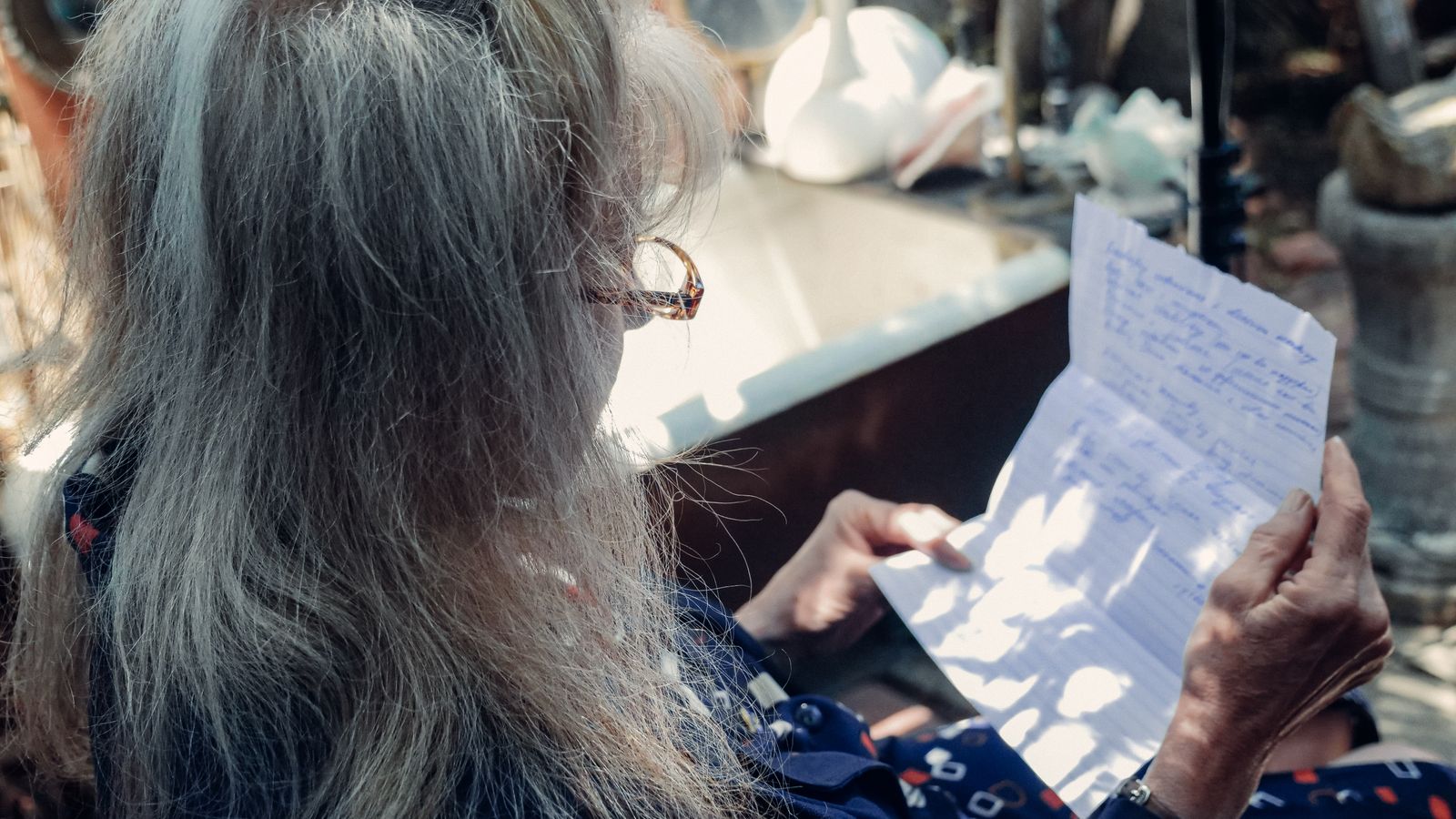
My grandmother spent her last years in an assisted living community with severe aphasia. She was sure she was speaking in sentences. To everyone around her, the words came out as sound without meaning. I talked about her on The Aging Well Podcast, and it is still hard to say:
“My paternal grandmother, she was in an assisted living facility. And she had severe aphasia... she believed that she was speaking words, but it would just sound like, blah blah blah... and it really broke my heart to see that.”
Patrick Donahue, on The Aging Well Podcast
Most life-story tools, including the first version of Porchlight, quietly assume the person can answer questions. A lot of residents in memory care cannot, or can only some days. If you are a family caregiver or an activity professional working with someone in the later stages of dementia, this article is about what life-story work can still look like, and what we changed in Porchlight after a long conversation with one of the most respected voices in dementia care.
What Lori La Bey taught me
Lori La Bey founded Alzheimer's Speaks and Dementia Map, and she has spent years helping families and professionals shift dementia care from crisis to comfort. When we met, she pointed out a gap I had not seen: an interview that waits for the resident to talk leaves out exactly the people who most need someone to know their story.
Her advice was practical. The story does not have to come from the resident's own mouth. A daughter, a spouse, or a longtime aide can tell it on their behalf, sitting beside them.
“It might still be a useful activity for people if they're sitting with a loved one and then they're talking about the person with dementia's life on their behalf.”
Patrick Donahue, on The Aging Well Podcast
And she changed what I counted as a response.
“Lori said that someone with dementia, it can be very hard for you to get any kind of a reaction out of them. So you might just have to... look at their face for a small smile or... get a few word acknowledgments.”
Patrick Donahue, on The Aging Well Podcast
Late in dementia, a small smile at a familiar song may be the whole conversation. It still counts.
She also talked about how many people with dementia respond better to older material: childhood, a story from when they were young, a song from their twenties. That matches what dementia educators commonly describe, that long-ago memories often stay reachable after recent ones fade.1 It varies a great deal from person to person, so treat it as a place to start, not a rule.
Practical life-story work for later-stage dementia
Whether or not you ever use software, these approaches work in a living room or a memory care neighborhood:
- Tell the story together. Sit beside them and tell part of their life out loud. "You grew up on a dairy farm in Wisconsin. You used to get up before dawn to milk." Watch their face as you go.
- Offer recognition, not recall. "Do you remember...?" is a test. "Was it the red barn or the white one?" or "You loved Glenn Miller, didn't you?" is an invitation they can answer with a nod.
- Lead with the senses. A song, a photograph, a familiar voice, the smell of coffee or bread. Music in particular often reaches people when words do not.
- Repeat freely. Short-term memory may be gone, so the same pleasant conversation can happen again tomorrow. On the podcast I said it plainly: you can talk with someone about fishing or baseball over and over, and if they love baseball, it is a good conversation every time.
- Write down what lights them up. The song that made them hum. The photo they reached for. The topic that made them turn away. That small log is gold for every caregiver who comes after you.
- Stop gracefully. If two questions in a row land in silence, end warmly. "Thank you for sitting with me." Not every day is a talking day.
“Even if the person does have... aphasia or dementia and it's very difficult to get through with them and forge that connection, that is the basis of what it means to be an effective caregiver. You're not just there to perform a task.”
Patrick Donahue, on The Aging Well Podcast
What we built in Porchlight for later-stage dementia
After that conversation, we rebuilt how Porchlight handles different stages of dementia. These features are live today. Here is exactly what they do.
A stage setting for each resident
Staff set each resident to early, middle, or later stage. In early stage, after a story and about eight seconds of quiet, a short countdown appears and the next question follows; speech cancels the countdown. Middle stage waits longer, about twenty seconds, and offers a gentle "take your time" nudge before moving on, with a simpler version of the question on a re-ask. Later stage is partner-paced: the tablet waits for the person sitting with the resident to move things along, uses a sensory-first order, offers faces instead of words for mood, and asks for spoken assent before recording. Staff can turn automatic advancing off for anyone.
It knows when to stop
If a resident answering on their own leaves two questions in a row unanswered, Porchlight stops with a warm spoken close instead of asking again and again. The session is marked as "no answers" so staff can see it and try a different approach next time, like sitting together or a listening session.
Proxy stories from family and staff
Family members, through their private page, and staff, through the coordinator dashboard, can answer questions about the resident in the third person, typed or spoken. "What did your mom do for work?" "What music did she love?" Those proxy stories feed the resident's Know Your Resident briefing, and the briefing names who supplied each detail. A resident who can no longer speak can still have a briefing that tells the next aide who they are.
Partner sessions stay honest
When a resident records together with a partner, the session is flagged as a conversation. The partner's words are kept out of the resident's "in their own words" quotes unless staff confirm them, so a daughter's memory never gets passed off as her mother's voice.
A question ladder
Each question has simpler rungs: an open version, an either/or version, and a yes/no version. "Tell me about the house you grew up in" can become "Was it in the city or the country?" and then "Did you grow up on a farm?"
Listening sessions and a reaction log
For someone with few words, a listening session lets a staff member or family partner play a family voice note, show a photo, or play a song, ask one simple question, and tap how the resident responded: smiled, sang or hummed along, talked about it, reached out, became calm, no clear reaction, or seemed upset. Positive reactions flow into the briefing under "What lights them up." Upset reactions flow into "Approach with care." That is Lori's small smile, written down where the whole team can see it.
An illustrative example
A resident in later stage no longer answers questions. Her son records proxy stories from home: she taught third grade for thirty years, she loved Patsy Cline, she grew roses. During a listening session an aide plays "Crazy" and taps "sang or hummed along." The next week, a new aide reads the briefing before her shift, hums a bar of Patsy Cline while helping with breakfast, and gets a smile back. (This is an illustration, not a real resident.)
What this is not
I will not tell you life-story work slows dementia or improves memory. The research on reminiscence in dementia shows modest, mixed benefits that depend on how and where it is done.2 Porchlight is a conversation and connection tool. It does not detect distress or diagnose anything; staff and family are the ones watching how a resident is doing, and they should stop any session that is not going well.
What it can do is make sure the person in the bed is known as more than a diagnosis, even after they can no longer tell you themselves. My grandmother deserved that. So does everyone in memory care.
As heard on The Aging Well Podcast
Patrick talked about his grandmother's aphasia and what Lori La Bey taught him about later-stage dementia with Dr. Jeff Armstrong. Listen to the full conversation, The Stories That Make Us: Why Being Known Matters as We Age (Episode 499, with Dr. Jeff Armstrong), or read the episode notes and highlights.
See later-stage mode, proxy stories and listening sessions
We'll show you how a resident who can no longer speak still gets a briefing that tells the next aide who they are.
Explore a live demo Book a demoSources & notes
- Alzheimer's Association, "Stages of Alzheimer's" and caregiver communication guidance, on long-term memory often persisting after short-term memory declines. Individual experience varies widely.
- Woods B, et al. Reminiscence therapy for dementia. Cochrane Database of Systematic Reviews, 2018. Effects were small and varied by setting and format. Porchlight is an enrichment and connection tool, not a clinical intervention.
- Lori La Bey, Alzheimer's Speaks (alzheimersspeaks.com) and Dementia Map.
- The Aging Well Podcast, Episode 499, "The Stories That Make Us: Why Being Known Matters as We Age," with Dr. Jeff Armstrong (October 2026).
Scenarios marked as illustrative are not real named individuals. Porchlight does not fabricate customers, testimonials, or outcome metrics. Podcast quotes are lightly trimmed of filler words; ellipses mark the cuts.