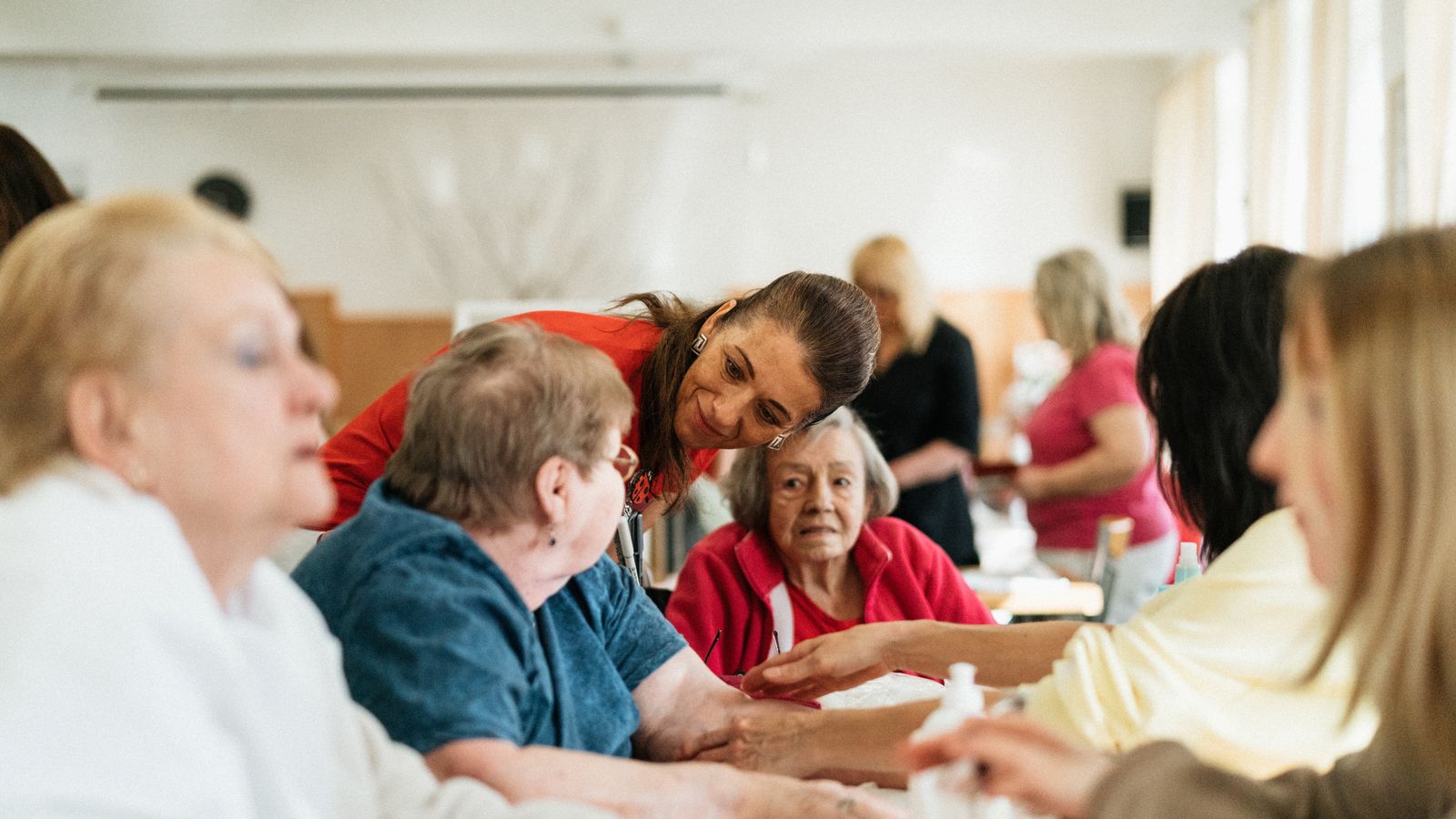
Picture Thursday dinner in an assisted living dining room. This is an illustration, but it is the kind of moment we built for. The activity director has printed the week's newsletter, and on the back page is a story from Harold in 2B: how he and two friends drove a borrowed Studebaker from Pittsburgh to the Grand Canyon in 1957 with eleven dollars between them. At table six, a woman who has barely spoken to Harold in a year leans over and says her late husband drove that same road. By dessert they are arguing about which diner in Amarillo had the better pie.
A care community is a strange place. Dozens of people who never chose each other share hallways, meals and a staff. Many arrive grieving: a house, a spouse, a car, the ability to come and go. It is easy for a building like that to feel like a waiting room. It is also possible for it to feel like a neighborhood. One of the quiet differences, we think, is whether people know each other's stories.
Stories change how staff see residents
The most consistent finding in the research on life story work is not about residents at all. It is about staff.
- Qualitative studies keep returning to the same phrase: life story work helps staff "see the person behind the patient" or behind the dementia.1
- In the UK's largest feasibility study of life story work, staff scores on a standard measure of attitudes toward dementia rose after life story work began, mainly on person-centredness. That gain was not sustained at later follow-ups, and the authors could not separate it from the training that came with it.2
- In an experiment with 95 long-term care workers, those who read a resident's life story along with the medical file reported more empathy, more confidence, and a lighter-seeming workload, and saw the resident as less dependent.3
- In a cluster trial across 20 German care facilities, staff who built small care plans from each resident's biography reported less time pressure and less job dissatisfaction.4
That last one matters more than it sounds. Caregiving burnout is not only about workload. It is also about meaning. An aide who knows that the man she is helping into his chair once built bridges is doing a different job from one who is getting room 2B ready for lunch.
Stories change how families and staff get along
Conflict between families and staff is one of the quiet costs of care. A study of 655 nursing home nurses and aides found that conflict with families raised burnout and lowered job satisfaction, and that conflict rose when staff lacked time and fell when expectations were shared.5 On the family side, conflict with staff predicted more guilt among Dutch family caregivers over the first year after placement.6
What families say they want is surprisingly modest. In a study of relatives during COVID visiting bans, families got general information but wanted to hear about their person's everyday life without having to ask.7 A shared story is a small piece of exactly that. When an aide mentions Harold's road trip to his daughter at the door, she hears something she cannot get from a care update: they know him.
There is good evidence that relationships between families and staff can improve, though the interventions that proved it were human, not technological. The Partners in Caregiving trial in 20 nursing homes trained families and staff in communication and brought them together, and both groups' attitudes toward each other improved, families of residents with dementia reported less conflict, and staff were less likely to say they would quit.8 Life story books have also improved relatives' ratings of their relationship with the person in care.9
A community is not a building full of people. It is a building full of people who know a little about each other.
Stories change how residents see each other
This is the part the research measures least, and the part you can see most easily on a good day. Residents who know each other's stories have something to talk about besides the weather and the food. A former teacher and a former principal discover they worked in the same district. Two people who grew up on farms argue about tractors. The newsletter gives a shy resident a way to be known without having to speak up in a group.
On the podcast this fall, I put it this way:
“Hopefully by incorporating Porchlight into these assisted living facilities, you'll be able to humanize and create like a stronger community between your caregivers and your different residents.”
Patrick Donahue, on The Aging Well Podcast
A newsletter that people actually read
Most community newsletters are a calendar, a birthday list and a menu. They are useful and nobody keeps them. A newsletter built around one or two real stories from residents is different. Families forward it. Residents read it to each other. Staff learn something about the people they care for without being sent to training.
A few things make it work. Use the resident's own words wherever you can, lightly edited, because a voice on the page is what makes a story land. Keep each story short, a few hundred words at most, with a photograph if the resident agrees. Rotate, so that over a year most residents who want to be featured are, not just the talkative few. Include a question at the end that invites a reply: "Did anyone else drive Route 66?" And always show the resident the piece, or read it to them, before it goes out.
One more thing. Stories about the quiet residents often matter most. The man who never comes to bingo may have flown cargo planes over the Himalayas. A newsletter is one of the few places he can be known without having to perform.
Where this can go wrong
Sharing stories in a community is not automatically good, and three cautions come straight from the research.
- Consent comes first. Some memories are private. Researchers have found sensitive material surfacing that the person never meant to be written down, and in one US pilot residents became less willing to share their life story books with others over time.10 Nothing should go in a newsletter or on a bulletin board without the resident's say, or their representative's.
- Group formats can burden families. A large UK trial of joint reminiscence groups for people with dementia and their family carers found no benefit, and carers in the reminiscence groups reported more anxiety at ten months.11 Family involvement should be an invitation, never an obligation.
- Do not freeze anyone. A story about who someone was should never become a box they are kept in. People are still changing at 90.
What you can try this month
You do not need any product to start. Ask three residents, with their permission, for one story each. Print them on a single page with a photograph. Leave copies on the dining tables. Watch who talks to whom. If you lead activities, consider a monthly story circle, using our group session guide, and keep it voluntary.
How Porchlight helps a story travel
Porchlight is built so that one telling can reach several kinds of listener. A resident records a story in their own voice. Their family hears it on a private page and can reply with a voice note. Staff get a short briefing and conversation starters. And the activity director can build a community newsletter from the week's stories, so a story can reach the dining room as well as the family, with consent. A paper consent form with an opt-out and a "who sees what" page are part of the setup.
We have not measured whether a story newsletter changes the attitude of a whole community, and nobody else has either. We are honest that it is a bet. But it is a bet grounded in what the research does show: when people know each other's stories, they tend to treat each other a little more like people.
One telling, many listeners
See how a resident's story reaches family, staff and the community newsletter, with consent.
Explore a live demo Book a demoSources & notes
- McKeown J, et al. International Journal of Older People Nursing 2010;5(2):148-158. doi:10.1111/j.1748-3743.2010.00219.x; and Cooney A, O'Shea E. Dementia 2019;18(7-8):2731-2746. doi:10.1177/1471301218756123.
- Gridley K, Brooks J, Birks Y, Baxter K, Parker G. Improving care for people with dementia: development and initial feasibility study for evaluation of life story work in dementia care. Health Services and Delivery Research 2016;4(23). doi:10.3310/hsdr04230. Approaches to Dementia Questionnaire median rose from 83 to 87 at first follow-up (p=0.004); later follow-ups were not significant.
- Muller C, Missotten P, Adam S. Clinical Gerontologist 2020. doi:10.1080/07317115.2020.1845897. A vignette experiment with 95 staff; it measured attitudes, not behaviour.
- Berendonk C, Kaspar R, Bär M, Hoben M. DEMIAN cluster-randomised trial. Dementia 2019;18(4):1286-1309. doi:10.1177/1471301217698837.
- Abrahamson K, Suitor JJ, Pillemer K. Journal of Aging and Health 2009;21(6):895-912. PubMed 19602705.
- Gallego-Alberto L, et al. Three-wave study of 222 Dutch family caregivers. Dementia 2022;21(1):5-20. PubMed 34250841.
- Eriksson E, Hjelm K. BMC Geriatrics 2022. PubMed 36008775.
- Pillemer K, et al. Partners in Caregiving randomised trial, 20 nursing homes. The Gerontologist 2003;43(Spec No 2):96-106. PubMed 12711730.
- Subramaniam P, Woods B, Whitaker C. Pilot randomised trial, 23 care-home residents. Aging & Mental Health 2014;18(3):363-375. PubMed 24063317.
- McKeown J, et al. Dementia 2015;14(2):238-256. doi:10.1177/1471301213495864. And Ejaz FK, Rose M, Polk M. Pilot of life story books, summaries and staff action plans in 16 nursing homes. Journal of Applied Gerontology 2022;41(1):124-133. doi:10.1177/07334648211008682. No control group.
- Woods RT, et al. REMCARE trial. Health Technology Assessment 2012;16(48). PubMed 23211271. 488 pairs; no benefit on primary outcomes, higher carer anxiety at 10 months.
- The Aging Well Podcast, Episode 499, "The Stories That Make Us: Why Being Known Matters as We Age," with Dr. Jeff Armstrong (October 2026). youtu.be/d-E4wfpVCQo. The timestamp link goes to the moment quoted.
Scenarios marked as illustrative are not real named individuals. Porchlight does not fabricate customers, testimonials, or outcome metrics. Podcast quotes are lightly trimmed of filler words; ellipses mark the cuts.