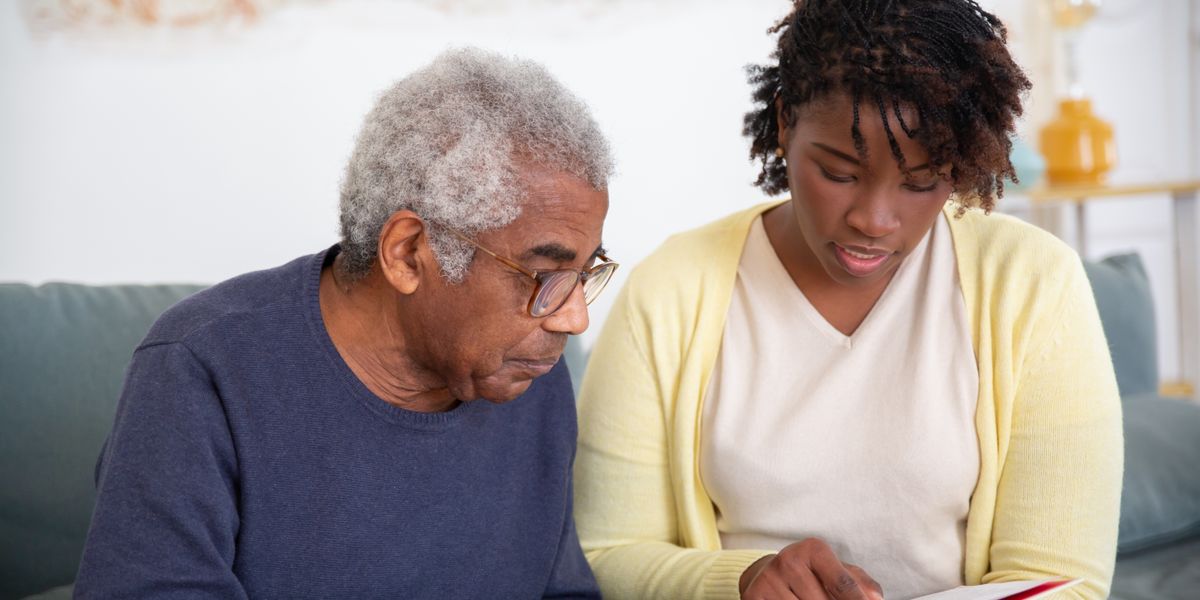
It is 6:40 in the morning. Picture an aide, call her Rosa, standing outside room 14 with a towel over her arm. It is her second week, and she has never met the woman inside. The care plan says what she needs help with: transfer assist, two-person if agitated, likes her coffee black. It says nothing about who she is. Rosa knocks, goes in, and the woman pulls the blanket up to her chin and tells her to get out.
Now run the same morning again, with one difference. On the door there is a small card. Call me Dot. I taught second grade for 31 years. I like the radio on before anyone touches me. Ask me about my garden. Rosa turns on the radio, says "Good morning, Dot," and asks whether the tomatoes did well this year. Morning care still has to happen. But it happens to a person who has been greeted as herself.
That small difference is the whole argument of this article. When the people caring for you know your story, care tends to get warmer, and sometimes it gets safer. The evidence for that is real, though it comes with an important catch, which we will get to.
Being known is where person-centred care starts
The modern idea of person-centred dementia care goes back to the psychologist Tom Kitwood, who argued in 1997 that a person's wellbeing depends on the people around them sustaining their "personhood." Treating someone as a task, talking over them, or ignoring what they say all wear it away.1 Dawn Brooker later summarized person-centred care in four parts, and one of them, the individualised approach, depends directly on knowing a person's history, preferences and routines.2
US regulation agrees, at least on paper. Nursing homes must make a comprehensive assessment of each resident's "needs, strengths, goals, life history and preferences." That is not a marketing phrase. It is federal law, 42 CFR 483.20(b)(1).3 Most states' assisted living rules ask for some version of preferences and routines too, which we cover state by state in our state rules library.
The most striking line, though, comes from the guidance surveyors use when they inspect nursing homes. Among the warning signs listed for the use of physical restraints, CMS writes that "staff state that new staff and/or temporary staff do not know the resident, how to approach, and/or how to address behavioral symptoms."4 In other words, the regulator itself names not knowing the person as a root of harm.
What the research shows
The strongest evidence is a step removed from life stories themselves. It comes from trials of care that is built around knowing the person.
- Agitation often has a reason. Jiska Cohen-Mansfield and colleagues found that agitated nursing home residents had, on average, three unmet needs each. The most common were boredom, loneliness, and the need for meaningful activity.5 You can only meet those needs if you know what this particular person finds meaningful.
- Matching care to the person helps. In a controlled trial in 12 nursing home buildings, interventions matched to residents' needs and "lifelong habits and roles" reduced agitation and increased pleasure and interest compared with usual care.6
- Person-centred programs make a measurable, modest difference. The WHELD trial in 69 UK nursing homes trained staff in person-centred care and social interaction. Quality of life and agitation improved by small amounts, and positive care interactions rose by about 20%.7 Earlier, the CADRES trial found lower agitation with person-centred care.8
- Knowing the story changes how staff see the person. In an experiment with 95 long-term care workers, staff who read a resident's life story alongside the medical file reported more empathy and more confidence, saw the resident as less dependent, and felt the workload was lighter than staff who read the medical file alone.9
On the podcast this autumn, I tried to say the same thing more simply:
“Instead of being like patient 29, you know, this is Jeff with a daughter in Seattle... it would help that caregiver to build that relationship and put that person to ease.”
Patrick Donahue, on The Aging Well Podcast
The catch: most life stories go unread
Here is the part that most companies in this space leave out. The biggest study of life story work in UK dementia care, run for the National Institute for Health Research, found that making life story books improved staff attitudes, at least at first. It did not find a clear quality-of-life gain for most residents. And it found something more basic: the books mostly were not used. In the authors' words, "Doing LSW is one thing; using it to inform and improve care is clearly another."10
When carers were asked how often staff looked at their relative's life story, the most common answer was "I don't know," and "never" came up as often as "weekly." Only about a quarter of services let all staff see it. Most kept it in the care record, where a busy aide at 6:40 a.m. will never open it.10 We wrote a whole piece on why: why life story binders go unread.
A story in a binder helps nobody. A story on the door, in the first thirty seconds, can change a morning.
So does it improve care? Conditionally, yes.
Put the evidence together honestly and you get a conditional yes. Knowing a resident's story can make care more person-centred, under four conditions:
- The people on shift actually see it, including new and agency staff, in seconds, where they work.
- It turns into actions, not just a nice biography. "She calms down with the radio on" is worth more than three pages about her childhood. See from story to care plan.
- It stays current and consented. People change. What someone loved at 60 may frustrate them at 90, and the story must never override what they want today.
- Someone champions it. Every positive trial above came with training or a staff champion. A document alone is the weakest version.
Under those conditions, the realistic expectation is a small-to-moderate improvement: fewer hard mornings, more good conversations, staff who feel more confident. Not a miracle. A real difference for real people, which in a care home is a lot.
What it feels like from the other side of the blanket
It is worth sitting for a moment with Dot's side of that morning. She is 91. She has lived in this building for eight months. In that time, by her count, she has been helped out of bed by more people than she can name. Every one of them was kind enough. Most of them called her "honey." Very few of them knew she spent three decades teaching seven-year-olds to read, or that she still corrects grammar in her head, or that the radio was how she started every school day of her working life.
Being cared for by people who do not know you is lonely in a particular way. You are touched constantly and known by almost no one. This is what Kitwood meant by personhood. What wears it away is rarely cruelty. It is being handled as a task by people who have no way to know who you are.1 A card on the door is a small thing. To Dot, it is the difference between being a room number and being herself, before the first word is spoken.
And notice what the card did for Rosa. She did not need more time. She needed thirty seconds of the right information. That is the whole design problem: not "how do we write a better biography," but "how do we hand the right three lines to the person at the door."
What you can do this week
If you are a family member, write five lines for the staff and ask where they will be kept: what your parent likes to be called, how to approach them, what calms them, what upsets them, and one thing to talk about. If you are on a care team, ask yourself honestly where your residents' stories live, and whether the person on the overnight shift could find them.
How Porchlight tries to meet those conditions
Porchlight is our attempt to make the four conditions easy. Residents record their own stories, in their own voice, by tapping one button and answering questions read aloud. The stories become a short Know-Your-Resident briefing with conversation starters, a printable door card, and a first-shift card written for someone meeting the resident for the first time. Topics to avoid sit on the profile. New stories show up on the staff Today page, and the coordinator gets a weekly digest every Monday. The family can listen too, and reply.
I want to be clear about what that is and is not. Porchlight is a conversation and keepsake tool, not therapy. It does not diagnose anything or detect distress, and AI's job is limited to transcribing and tidying what a resident said. No one has run a trial of a software briefing like ours, including us. What we can say is that it is built around what the research says matters: the story has to reach the person at the door.
Put the story where the care happens
See the briefing, door card and first-shift card a resident's own stories become.
Explore a live demo Book a demoSources & notes
- Kitwood T. Dementia Reconsidered: The Person Comes First. Open University Press, 1997.
- Brooker D. What is person-centred care in dementia? Reviews in Clinical Gerontology 2004;13(3):215-222. doi:10.1017/S095925980400108X.
- 42 CFR 483.20(b)(1), Resident assessment (F636). ecfr.gov.
- CMS State Operations Manual, Appendix PP (Rev. 225, 2024), guidance to surveyors for long-term care facilities. cms.gov. The quoted line appears in the guidance on physical restraints.
- Cohen-Mansfield J, et al. Psychiatry Research 2015. doi:10.1016/j.psychres.2015.03.043. 89 residents in 6 Maryland nursing homes.
- Cohen-Mansfield J, Libin A, Marx MS. J Gerontol A Biol Sci Med Sci 2007;62(8):908-916. doi:10.1093/gerona/62.8.908.
- Ballard C, et al. WHELD cluster-randomised trial. PLoS Medicine 2018;15(2):e1002500. doi:10.1371/journal.pmed.1002500. 69 nursing homes; effects were small (d about 0.2 to 0.3), positive care interactions +19.7%.
- Chenoweth L, et al. CADRES cluster-randomised trial. Lancet Neurology 2009;8(4):317-325. doi:10.1016/S1474-4422(09)70045-6.
- Muller C, Missotten P, Adam S. Clinical Gerontologist 2020. doi:10.1080/07317115.2020.1845897. A vignette experiment with 95 staff; it measured attitudes, not behaviour.
- Gridley K, Brooks J, Birks Y, Baxter K, Parker G. Improving care for people with dementia: development and initial feasibility study for evaluation of life story work in dementia care. Health Services and Delivery Research 2016;4(23). doi:10.3310/hsdr04230. Usage figures are from the carer survey (Table 34) and the national provider survey.
- The Aging Well Podcast, Episode 499, "The Stories That Make Us: Why Being Known Matters as We Age," with Dr. Jeff Armstrong (October 2026). youtu.be/d-E4wfpVCQo. The timestamp link goes to the moment quoted.
Scenarios marked as illustrative are not real named individuals. Porchlight does not fabricate customers, testimonials, or outcome metrics. Podcast quotes are lightly trimmed of filler words; ellipses mark the cuts.