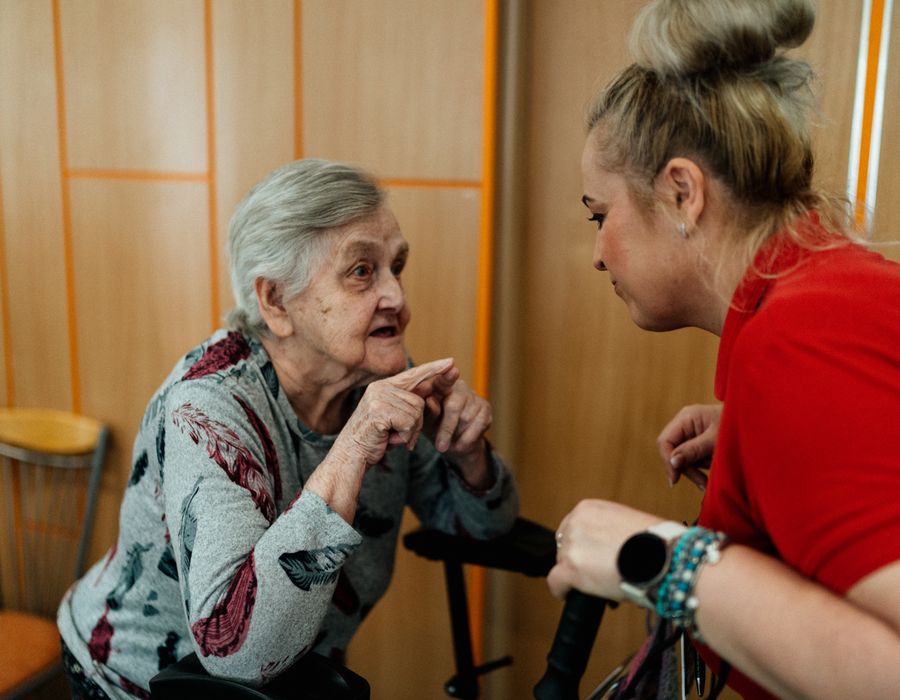
Think about the people who have helped you get dressed in your life. For most of us the list is short: a parent, a partner, maybe a nurse after surgery. Now picture an illustrative resident, a retired machinist named Walt, 89, in a memory care neighborhood. Over the past year, the list of people who have helped Walt get dressed, showered and into bed probably runs into the dozens. Some of them he saw for months. Some he saw once, on a Sunday, when the regular aide called out and an agency worker came instead.
Every one of those people had to learn Walt from scratch. That he hates being rushed. That he was in the Navy and still makes his bed with hospital corners. That if you call him "sweetie," the morning is over. Each time someone new walks in, Walt has to be met by a stranger again. This article is about that stranger at the door: how often it happens, why it matters, and what actually helps.
How much turnover are we talking about?
The numbers depend on how you count, and the honest thing is to show more than one.
- Nursing homes, counted by hours worked: a study of payroll data from 15,645 US nursing homes found mean annual turnover of nursing staff around 128%, with a median around 94%. In a typical building, that means nearly the whole nursing staff can turn over in a year.1
- Nursing homes, counted by headcount: the industry's own salary survey, using a different method, put CNA turnover at about 42% in 2025.2
- Assisted living: an industry survey of 961 communities reported turnover of about 47% for resident assistants and personal care aides and about 42% for CNAs.3
- Agency staff: by 2022, agency and contract workers provided about 11% of direct-care nursing hours in US nursing homes, up from 3% in 2018.4
Whichever figure you pick, the conclusion is the same. A resident who lives in a community for two years will be cared for by many people who did not know them when they arrived, and a growing share who have never met them at all.
Why it is so hard to keep people
It is easy to talk about turnover as if it were a character flaw in the workforce. It is not. Nursing assistants in nursing and residential care earn a national median of about $42,000 a year, and personal care aides in assisted living earn less.5 Many work two jobs. The work is physical, emotionally heavy, and often understaffed. In US nursing homes, aide time averages a little over two hours per resident per day, and that has to cover everything: bathing, dressing, toileting, meals, turning, and comfort.6
So when we say "staff should get to know each resident," we are asking people with very little time to do something that normally takes months. That is the problem in one sentence.
What the stranger at the door costs
On the podcast, I described what that first meeting is like from the caregiver's side:
“When you enter the room as a caregiver, you know, with a new resident, let's say you've just joined the team... You might have to like empty their bedpan. You might have to turn them over to avoid bed sores... it's a difficult situation for both sides because the caregivers are rotating.”
Patrick Donahue, on The Aging Well Podcast
For the resident, being met by a stranger means intimate care from someone who does not know how they like it done, and who may not understand what they are trying to say. For someone with dementia, a refusal or a raised voice is often a message: I am scared, I am cold, this is not how I do things. Research on agitation in nursing homes finds that it often signals unmet needs, most commonly boredom, loneliness and the lack of anything meaningful to do.7 A new aide has no way to read those messages yet.
For the aide, it means walking into a hard moment without a map. And CMS has said plainly where that can lead. Among the warning signs surveyors look for around physical restraints: "staff state that new staff and/or temporary staff do not know the resident, how to approach, and/or how to address behavioral symptoms."8
The resident does not experience turnover as a statistic. They experience it as a new face at 6 a.m., again.
Does keeping the same staff fix it?
Consistent assignment, where the same aides care for the same residents, is the textbook answer, and it helps. A study of 3,941 nursing homes found that while about two thirds said they used it, only 28% did so at the recommended level, and those that did had lower aide turnover and absenteeism.9 A recent large English study of care homes found that personalised care depended on staff stability and enough staff to build "familial" relationships and really know residents.10
But a review of 20 studies found the effects of consistent assignment on quality outcomes were inconsistent.11 And no schedule can promise the same face on every shift when a quarter of the team may leave this year. Consistency is worth fighting for. It is not enough on its own. Knowledge of the person has to travel separately from any one employee, so it does not walk out the door when they do.
What a new caregiver actually needs to know
Not a biography. A new aide on a full hallway has seconds, not minutes. In those seconds, the useful things are:
- The name they want. "Walt," not "Walter," and never "honey."
- How to approach. From the front, slowly, explain before touching.
- What comforts them. The radio, a warm towel, talking about the Navy.
- What upsets them. Being rushed. Mention of a late spouse at bedtime.
- One thing to talk about. A real door into a real conversation.
That is five lines. It fits on a card. It is the difference between meeting a stranger and meeting someone you were told about by a friend. If you are new on a team yourself, our guide for your first shift with a new resident goes further.
What families can do
If your parent lives in a community, you are the one constant in a building where the faces keep changing. That gives you a quiet kind of power. Write the five lines above yourself, on one page, and hand a copy to the nurse, the activity director and whoever runs the memory care neighborhood. Ask where it will be kept, and whether an agency aide on a Sunday would see it. Tape a copy inside the closet door if the staff are comfortable with that.
Update it when things change. If your father used to love the Navy stories and now gets upset when anyone mentions the war, cross it out. If he has started humming hymns at night, add it. The page should describe who he is now, with the past as the way in.
And when you meet a new aide, introduce your parent the way you would introduce him to a friend: "This is Walt. He built engines for forty years. He likes to be told what you're about to do." You may be the only person that week who does.
Where Porchlight comes in
We built Porchlight around that stranger at the door. Residents tell their own stories by tapping one button and answering questions read aloud, and those stories become a Know-Your-Resident briefing, a printable door card, and a first-shift card meant for exactly the agency aide on a Sunday morning. Topics to avoid sit on the resident's profile. Because the knowledge lives with the resident and not in one person's head, a new aide, a new activity director or a new nurse inherits it on day one.
That will not fix wages or staffing levels, and we would never claim it does. It also has not been tested in a trial; no software briefing has. What it does is make the five lines above easy to have, for every resident, before the knock on the door.
Knowledge that stays when people leave
See the first-shift card a new or agency caregiver gets before meeting a resident.
Explore a live demo Book a demoSources & notes
- Gandhi A, Yu H, Grabowski DC. Health Affairs 2021;40(3):384-391. doi:10.1377/hlthaff.2020.00957. Based on payroll data from 15,645 nursing homes.
- American Health Care Association / Hospital & Healthcare Compensation Service, 2025-2026 Nursing Home Salary & Benefits Report (headcount-based turnover). ahcancal.org.
- Hospital & Healthcare Compensation Service with LeadingAge and NCAL, 2023-24 Assisted Living Salary & Benefits Report (961 communities), as summarized by McKnight's Senior Living.
- Health Affairs 2024, contract staff in nursing homes, doi:10.1377/hlthaff.2023.01101; and ASPE issue brief on contract staffing in nursing homes (January 2025).
- US Bureau of Labor Statistics, Occupational Employment and Wage Statistics, May 2025, NAICS 623 (nursing and residential care facilities), national medians.
- KFF. A look at nursing facility characteristics (July 2025): 3.85 nursing hours per resident per day, of which aides provide 2.30. kff.org.
- Cohen-Mansfield J, et al. Psychiatry Research 2015. doi:10.1016/j.psychres.2015.03.043. 89 residents in 6 Maryland nursing homes.
- CMS State Operations Manual, Appendix PP (Rev. 225, 2024), guidance to surveyors for long-term care facilities. cms.gov.
- Castle NG. Journal of Aging & Social Policy 2013. doi:10.1080/08959420.2012.705647. Cross-sectional, 3,941 nursing homes.
- Spilsbury K, et al. StaRQ study. NIHR Health and Social Care Delivery Research 2024;12(8). doi:10.3310/GWTT8143.
- Roberts T, Nolet K, Bowers B. The Gerontologist 2015. doi:10.1093/geront/gnt101.
- The Aging Well Podcast, Episode 499, "The Stories That Make Us: Why Being Known Matters as We Age," with Dr. Jeff Armstrong (October 2026). youtu.be/d-E4wfpVCQo. The timestamp link goes to the moment quoted.
Scenarios marked as illustrative are not real named individuals. Porchlight does not fabricate customers, testimonials, or outcome metrics. Podcast quotes are lightly trimmed of filler words; ellipses mark the cuts.