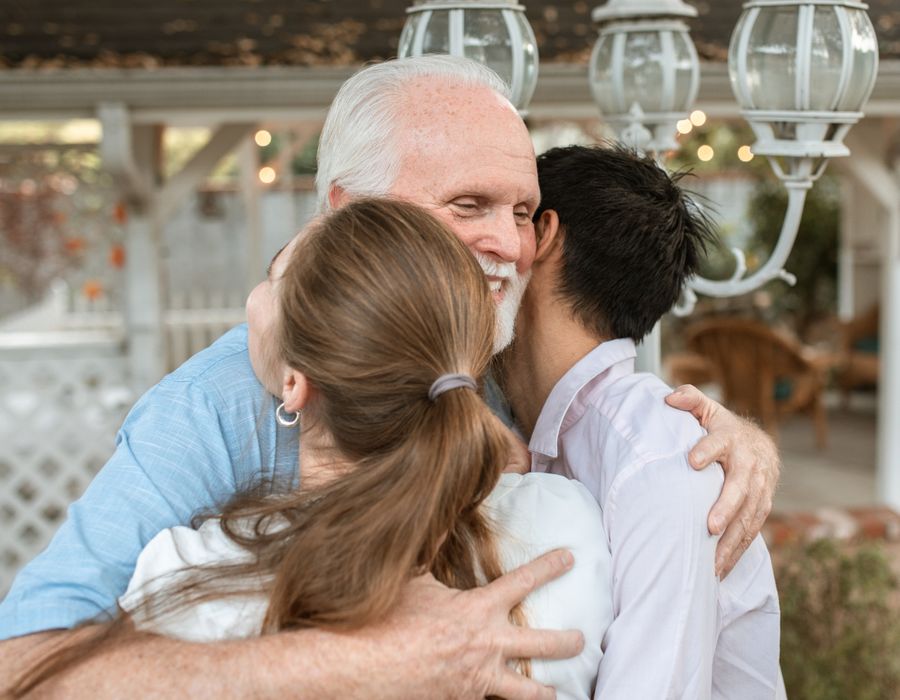
A story told once to a single listener is a gift. A story told once and heard by everyone who needs it is something else. That second idea is what Porchlight is built around, and I want to explain where it came from.
Where this started
My father died around the time my first daughter was born. We had good conversations in his last week, and I am grateful for every one of them. But afterward I kept thinking about how much he could have passed on, and how little of it was written down or recorded anywhere. My daughter will grow up knowing his name and a few photographs. She will not know his voice.
On a shelf in my office I keep my grandfather's World War II medals, including his Purple Heart, and photographs of relatives in Knox County, Tennessee, whom I never met. Those things matter to me. They are also almost silent. I know he served. I do not know what he thought about it.
Years before Porchlight, I lived in Germany for six years. Because I spoke the language and had the patience to sit and listen, I got to know people in their seventies and eighties who had lived through events that broke the world in half. Some of the most important conversations of my life were with old people who simply had not been asked before.
And my mother was a hospice nurse for twenty years. I grew up hearing what the end of a life looks like from the side of the person caring for it.
Put those together and you get the question behind this company. Why do the people with the most to tell so rarely get a listener, and why does what they say so rarely reach the people who need it?
The listeners a story actually has
When a woman in assisted living tells the story of how she met her husband, there are more people who should hear it than anyone usually counts.
Her family, now. The daughter who visits on Sundays, and the son three states away who calls when he can. Families of people in care say the thing they miss is everyday life, news of their person that arrives without having to ask.1
Her family, later. The grandchildren who are too young to care right now and will care very much at forty. Nearly half of American adults say they regret not recording a conversation with someone close to them who has died.2
The aide on tomorrow's early shift. Maybe she has worked there for years; maybe it is her third day, sent by an agency. Either way she will walk into that room to help with the most private parts of the day. On The Aging Well Podcast I tried to describe the difference knowing someone makes:5
“instead of being like patient 29 you know this is jeff with a daughter in seattle”
Patrick Donahue, on The Aging Well Podcast
The activity director. The person who plans a month of programs for forty people with forty histories, and who is required by many care rules to build activities around residents' interests and life roles.3
Her neighbors. The woman across the hall who also grew up on a farm. The man at her dinner table who was also in the Navy. Shared stories are how strangers in a building become a community.
Herself. There is good evidence that reviewing your own life, over several sessions, with someone listening, can help people make sense of it, especially when it is structured to find meaning rather than rehearse old wounds.4 The first listener of a life story is the teller.
Tell it once. Let everyone who needs it hear it.
Why "once" matters
Here is the practical problem. Every one of those listeners currently has to get the story separately, if they get it at all. The daughter hears a version on Sunday. The admissions nurse writes three lines on an intake form. The activity director sends a questionnaire to the family. The new aide gets nothing. The grandchildren get nothing. And the resident, who is often tired and sometimes losing words, is asked to repeat herself to each new person, or more often is never asked.
And the people who most need the story change constantly. In US nursing homes, nursing staff turnover runs near or above 100 percent a year by some measures, and agency workers now cover a real share of shifts. A story told to one aide in March may have left the building by June. A story that lives only in one person's memory, even a caring person's, is one resignation away from gone.6
Porchlight's idea is simple. Let her tell it once, in her own voice, at her own pace, and let it reach everyone who should hear it, in the form each of them can use. The family gets her voice, which they can keep and answer. The staff get a short briefing they can read before a shift. The activity director gets raw material and a newsletter. The neighbors get the stories she is happy to share. She gets a listener, every time she wants one.
Underneath that is a belief about what care is. On the podcast I put it this way:
“You're not just there to perform a task. It's also about how you make the other person feel”
Patrick Donahue, on The Aging Well Podcast
What I am careful about
A vision is easy to inflate, so here is what this one does not mean.
- It does not mean every story goes to every listener. Some stories are for family only. Some are for no one but the teller. A story about a lost child is not door-card material. The resident, or the person who speaks for them, decides, and staff can mark topics to avoid.
- It does not mean a machine does the listening. AI in Porchlight transcribes and tidies. It does not choose the questions, which are written by people and asked in a set order. It does not detect distress or diagnose anything. The listening that matters is human.
- It does not mean the past outranks the present. A story is a way to understand who someone is now, not a portrait to freeze them in.
- It does not mean we have proven it. The research behind each piece is real, and some of it is strong. No one has studied the whole idea end to end. We would rather help a community measure it honestly than claim results we do not have.
What it looks like when it works
Picture it, as an illustration. A resident named June records the story of the summer she worked at a cannery on the coast. Her son in Denver hears it on his lunch break and sends back a thirty-second voice note: he never knew. Her granddaughter downloads it, without quite knowing why. The aide who helps June in the mornings reads one line on the first-shift card, "worked a cannery one summer, ask about the radio they played on the line," and the next morning goes differently. The activity director puts the story in the newsletter, and at dinner the man across the table says he worked the same coast.
Nothing in that picture is dramatic. It is one story, told once, finding its listeners. Multiply it by every resident and every week, and you get a building where people are known. That is the whole vision. Everything we build is in service of it.
If you want to see how far we have gotten, the live demo shows the resident screen, the staff briefing and the family page. And if you never use Porchlight, I hope you will still ask someone you love to tell you a story this week, and tell one person who cares for them what you learned.
Patrick Donahue
Founder, Porchlight
See one story reach its listeners
The live demo follows sample residents' stories to the family page, the staff briefing and the newsletter.
Explore a live demo Book a demoSources & notes
- Eriksson E, Hjelm K. Qualitative study of relatives' experiences of communication with Swedish nursing homes during visiting bans. BMC Geriatrics 2022. PubMed.
- YouGov, survey of 6,090 US adults, May 31 to June 1, 2022: 47% regret not recording or documenting a conversation with a close person who has died. yougov.com.
- 42 CFR 483.24(c)(1) and CMS Appendix PP guidance for F679, which names residents' "lifelong interests, spirituality, life roles" as sources for activities. PDF.
- Pinquart M, Forstmeier S. Effects of reminiscence interventions on psychosocial outcomes: a meta-analysis. Aging Ment Health 2012;16(5):541-558 PubMed; Westerhof GJ, Slatman S. Clin Psychol Sci Pract 2019;26(4):e12301 doi.
- The Aging Well Podcast, Episode 499, "The Stories That Make Us: Why Being Known Matters as We Age," with Dr. Jeff Armstrong (October 2026). See the episode notes.
- Gandhi A, Yu H, Grabowski DC. Payroll-based analysis of 15,645 nursing homes: mean annual nursing staff turnover about 128%, median about 94%. Health Affairs 2021;40(3):384-391. doi:10.1377/hlthaff.2020.00957.
Scenarios marked as illustrative are not real named individuals. Porchlight does not fabricate customers, testimonials, or outcome metrics. Podcast quotes are verbatim from the transcript.