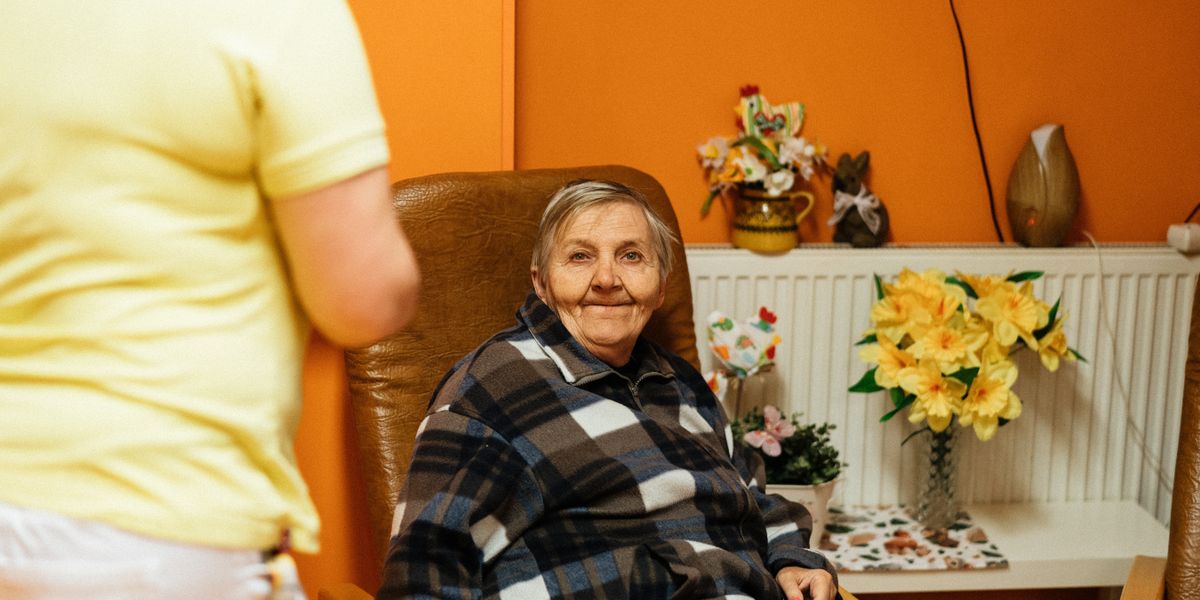
Say her name is Ruth. She is eighty-eight, she lives in the memory care neighborhood, and most afternoons around three she stands by the door with her purse over her arm. The chart says "exit-seeking." A new aide gently steers her back to her chair, and ten minutes later she is at the door again.
Ruth taught second grade for thirty-one years. School let out at three. Every afternoon of her working life, at exactly that hour, she gathered her things and went home to start supper.
That is an illustrative example, not a real resident. But anyone who has worked in memory care knows a Ruth. The behavior on the chart is real. What is missing is the person who explains it. This article is about why that person still matters after a dementia diagnosis, how to keep the story alive without freezing someone in the past, and what changes when the person can no longer tell the story themselves.
The person does not disappear
About 44 percent of people living in US assisted living have Alzheimer's disease or another dementia, and the share is higher in small homes.1 For a long time, care for them was organized around the disease: the stage, the deficits, the behaviors to manage. The shift away from that started with the British psychologist Tom Kitwood, who argued in the 1990s that a person's wellbeing in dementia depends heavily on whether the people around them keep treating them as a person.2
Kitwood had a blunt name for the opposite. He called it "malignant social psychology": talking over someone, infantilizing them, ignoring them, treating them as a task. Nobody sets out to do these things. They happen when a busy aide has twelve residents and no idea who any of them were.
Dawn Brooker later turned Kitwood's ideas into a working model of person-centered care with four parts, abbreviated VIPS: Valuing people, an Individualized approach, seeing things from the Perspective of the person, and a supportive Social environment.3 The "I" is where life history lives. You cannot individualize care for someone you know only by diagnosis.
Why the story helps: unmet needs
The most useful practical idea in this field comes from Jiska Cohen-Mansfield, who argues that much of what we call agitation is a person trying to communicate a need they can no longer put into words. In one study of 89 agitated nursing home residents, each person had on average three unmet needs. The most common were boredom, loneliness, and the lack of anything meaningful to do.4
Look at that list. Two of the top three needs can only be met by someone who knows what this person finds meaningful and how they like to be with people. That is exactly what a life story supplies. When Cohen-Mansfield's team matched interventions to residents' "lifelong habits and roles," agitation fell compared with control buildings.5 For Ruth, that might mean an aide who says at quarter to three, "Mrs. Becker, would you help me sort these papers before you go?"
The honest summary of the wider evidence is that this works, modestly. A Cochrane review of activities tailored to people's present or past interests found they may slightly reduce agitation, with low-certainty evidence and little change in rated quality of life.6 The Cochrane review of reminiscence work in dementia found small effects overall, somewhat larger in care homes, and no evidence of harm to the person with dementia.7 These are not miracles. They are small, real improvements in an afternoon, repeated across many afternoons.
The story is there to help us understand who she is now, not to preserve who she used to be.
The trap: freezing someone in the past
There is a risk in all this, and the people who study life story work name it clearly. In a large UK study, staff and families worried about residents being "set in stone" by a life story document.8 Someone who loved gardening may now find it upsetting because their hands no longer do what they want. A man who was proud of his piano playing may not want to be steered to a piano he can no longer play. The consensus in that study was simple: update the story, and never let it outrank what the person is telling you today.
Swedish researchers who read 30 life story templates found something related. The templates tended to produce one of two people: "a person before symptoms," frozen at some earlier point, or "a patient with dementia," reduced to the diagnosis.9 Neither is the person in the room.
A few rules follow from this:
- Keep past and present side by side. "Taught second grade" and "now prefers quiet mornings, gets anxious in crowds" both belong on the card.
- Write down what no longer works. A former love that now frustrates is just as useful to an aide as a current one.
- Long-term memory is relatively preserved, not intact. Do not test. Avoid "Do you remember...?" Ask "Tell me about..." or offer a choice instead.
- Current wishes win. If Ruth says she does not want to talk about school today, she does not.
What the telling does, and what the keeping does
One small study draws a line that is useful for anyone designing this work. Researchers ran one-to-one life review sessions with care home residents who had dementia and made a life story book with each of them. A comparison group received a book made by relatives as a gift. Right after the sessions, the residents who had been interviewed showed a bigger improvement in quality of life. Six weeks later, once both groups had books, that difference was gone. But in both groups, once the books existed, relatives reported a better relationship with the resident, and staff knowledge and attitudes improved.10
It was a pilot with 23 people, so it proves little on its own. But it suggests something worth keeping in mind. Being listened to seems to help the person in the moment. The finished story mostly helps the people around them: family and staff, who now see someone where they saw a diagnosis.
When the person can no longer tell it
Here is where many life story tools quietly stop working. They assume the storyteller can still hold a conversation. In later-stage dementia, that may not be true, and the tool keeps asking questions into silence. That is not neutral. A resident who is asked question after question and cannot answer is being tested, however kindly the questions are phrased.
Good practice in later stages looks different:
- Other people tell the story. Family, longtime friends and staff who know the person can record what they know, clearly marked as told by someone else. We wrote more about this in proxy life stories.
- Questions get smaller. "Tell me about your wedding" becomes "Was your wedding in summer or winter?" or "Did you like to dance?" A yes, a smile or a hand squeeze is an answer.
- Pace belongs to the partner. A family member or aide sits with the person and moves on only when it feels right.
- Silence ends the session gracefully. Two unanswered questions is enough. Close warmly and try another day.
- Listening counts too. Hearing a favorite song or a grandchild's voice is a way of being with someone, even with no words back.
A note on that last point, because it gets oversold. There is a body of research on playing family voice recordings to people with dementia, sometimes called simulated presence. Some residents respond with visible pleasure. Others become more distressed, searching for the person they just heard. A Cochrane review found the evidence too thin to draw conclusions.11 A voice message from family is a lovely thing to offer. It should be offered, watched, and paused if it upsets.
How Porchlight handles the stages
We built Porchlight for the whole course of a stay, not only the first good months. Each resident has a stage setting that staff choose: early, middle, or later.
- In the early stage, a resident taps one big button, hears a question read aloud, and talks. After a story and a short quiet, a countdown appears and the next question comes by itself; speaking cancels it.
- In the middle stage, the pause is longer and comes with a gentle nudge.
- In the later stage, nothing moves on its own. A partner sets the pace, questions come in either/or and yes/no versions, and after two unanswered questions the session ends with a warm close and a note to staff.
Family and staff can add proxy stories for a resident who can no longer tell them, and those count toward the resident's briefing. Recordings made with a partner keep the partner's words out of the resident's "own words." Families can reply with voice notes the resident can play, and staff decide when that is welcome.
What Porchlight does not do matters just as much. It does not detect distress or decline. It does not diagnose. The questions are written by people and asked in a fixed order, not chosen by AI. And it is not therapy. It is a way of making sure that the aide at quarter to three knows that Ruth was a teacher, and that the person she is today still deserves to be known.
A life story that works at every stage
See how early, middle and later-stage settings, proxy stories and family voice notes fit together.
Explore a live demo Book a demoSources & notes
- Centers for Disease Control and Prevention, National Center for Health Statistics. Data Brief 506 (residents of residential care communities, 2022). cdc.gov; size breakdown in Data Brief 454 cdc.gov.
- Kitwood T. Dementia Reconsidered: The Person Comes First. Open University Press, 1997.
- Brooker D. What is person-centred care in dementia? Reviews in Clinical Gerontology 2003;13(3):215-222. doi:10.1017/S095925980400108X.
- Cohen-Mansfield J, et al. Unmet needs of 89 agitated residents in six nursing homes. Psychiatry Research 2015. doi:10.1016/j.psychres.2015.03.043.
- Cohen-Mansfield J, Libin A, Marx MS. Controlled trial of individualized interventions in 12 nursing home buildings, n=167. J Gerontol A 2007;62(8):908-916. doi:10.1093/gerona/62.8.908.
- Möhler R, et al. Personally tailored activities for people with dementia in long-term care (11 studies, n=1,071). Cochrane Database of Systematic Reviews 2023. doi:10.1002/14651858.CD009812.pub3.
- Woods B, O'Philbin L, Farrell EM, Spector AE, Orrell M. Reminiscence therapy for dementia. Cochrane Database of Systematic Reviews 2018;3:CD001120. doi:10.1002/14651858.CD001120.pub3.
- Gridley K, Brooks J, Birks Y, Baxter K, Parker G. Health Serv Deliv Res 2016;4(23). doi:10.3310/hsdr04230.
- Möllergren & Harnett. Analysis of 30 Swedish life story templates. Dementia 2024. doi:10.1177/14713012231224545.
- Subramaniam P, Woods B, Whitaker C. Pilot randomised trial of life review and life story books in care homes (n=23). Aging Ment Health 2014;18(3):363-375. PubMed.
- Abraha I, et al. Simulated presence therapy for dementia. Cochrane Database of Systematic Reviews 2017, updated 2020. PubMed.
Scenarios marked as illustrative are not real named individuals. Porchlight does not fabricate customers, testimonials, or outcome metrics.