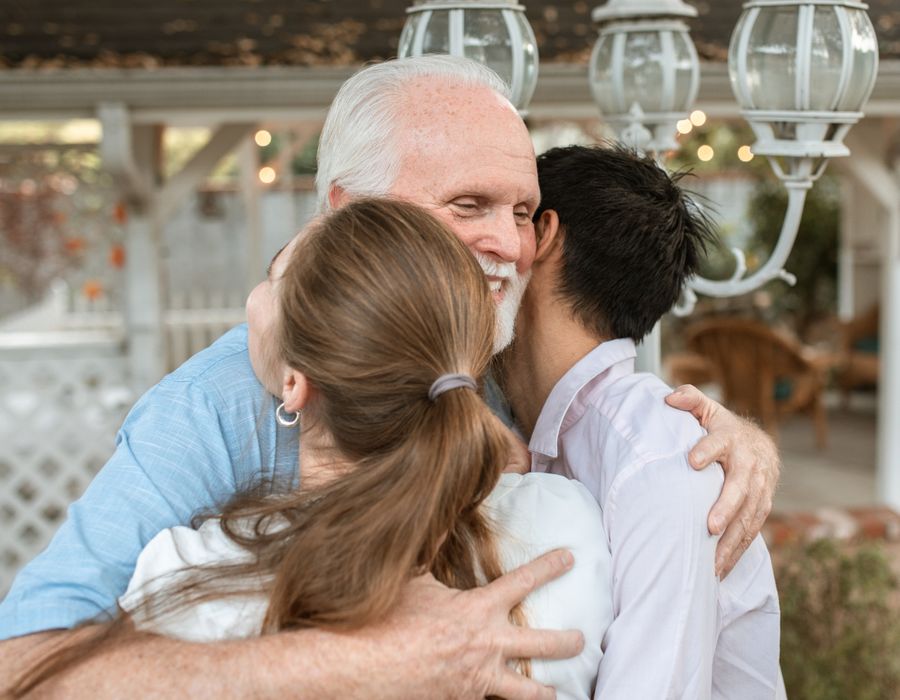
Picture a kitchen table in November. An illustrative family, but you probably know one like it. Three adult children, one widowed father, and a stack of options somebody printed out: a gift subscription that emails a question every week, a free recording app, a brochure from a personal historian, and a blank notebook with "Dad's stories" written on the cover in hopeful marker. Everyone agrees the stories should be saved. Nobody agrees on how. By Christmas the notebook has two pages filled in, both by the daughter.
That is the usual way it goes. The hard part of leaving your story is rarely the wish. It is picking a format that the person will actually finish, that sounds like them, and that someone will still be able to open in thirty years. This piece walks through the main ways people do it, plainly, with what each one is good at and where each one tends to stall.
First, what are you trying to keep?
Before comparing formats, it helps to name the job. There are really three, and most methods only do one or two of them well.
- The facts. Where they grew up, who they married, what they did for work. These fit on a page and families often already have them.
- The meaning. What they learned, what they are proud of, what they hope for the people they love. This is the part the research on legacy work says families value most. In the largest trial of Dignity Therapy, a structured legacy interview for people near the end of life, the intervention did not reduce distress, but patients rated it far more helpful to their families than the comparison conditions, and said it changed how their families saw and appreciated them.1 In a separate survey of bereaved relatives, 78% said the resulting document helped them in their grief.2
- The voice. How they actually sound telling it: the pause, the accent, the way they say your name. Of the three, this is the one families most often wish they had and least often do. In a 2022 YouGov poll of 6,090 US adults, 47% said they regret not recording or documenting a conversation with someone close to them who has died.3
Keep those three in mind. Now the options.
A letter or an ethical will
The oldest format there is. An ethical will, sometimes called a legacy letter, is a short document that passes on values and blessings instead of property. It can be one page.
Good at: meaning. It is short enough to finish, it costs nothing, and paper lasts. Where it stalls: it asks the writer to do all the work alone, and many people freeze in front of a blank page. It also captures almost none of the everyday texture, and none of the voice. If your parent is a writer, start here. If they are a talker, this may never get written.
A written memoir, by them or with help
Some people genuinely want to write their life down, chapter by chapter. A few will. Many start with childhood, reach their twenties, and stop.
Good at: depth and control. They choose every word. Where it stalls: it is a long project for someone who may have low vision, a tremor, or limited energy. And typing-first formats quietly exclude people who never wrote much but tell a story beautifully out loud.
The full-service version is a personal historian or ghostwriter, who interviews the person and produces a book. Commonly quoted prices run from several hundred dollars for a short recorded oral history to many thousands for a full memoir.4 The results can be lovely. It is a wonderful choice for one person. It does not scale to everyone in a family, let alone everyone in a building.
A question a week, by email or text
The best-known consumer products work this way. An adult child buys a subscription, the parent gets a prompt each week, answers in writing or by phone, and at the end of the year the answers become a printed book. As listed on their own sites in October 2026, StoryWorth's plans start at $69, and Remento charges $99 for the first year including one book, with answers recorded by voice and turned into text.5 StoryWorth reports more than a million books printed, which tells you how many families want this.6
Good at: steady progress and a finished book. The weekly rhythm is the genius of it. Where it stalls: it depends on the storyteller managing email or an app, every week, on their own. That works well for a healthy seventy-year-old. It works less well for someone who is 88, lives in assisted living, and does not check email. And the book goes to the family. The people who care for that person every day never see it.
Phone interviews by a service
A newer group of services call the person on the phone and interview them, then transcribe and write up the answers. Tell Mel, for example, lists packages from $39 to $219 depending on interview hours.5
Good at: no typing, and the voice is captured. Where it stalls: phone calls are hard for people with hearing loss, and a scheduled call can feel like an appointment to dread. Like the weekly prompt products, the output is built for family, not for the people providing care.
A recorded conversation, do it yourself
The free option, and an excellent one. Sit with them, put a phone face down on the table, and ask. StoryCorps has shown at enormous scale how much a single recorded conversation can hold, with interviews archived at the Library of Congress.6 We wrote a whole guide to doing this at home: record your parent's voice while you can.
Good at: voice, warmth, cost. Where it stalls: it depends on someone being in the room, more than once. Families who live far away, or who see Mom only on holidays with twenty people talking, rarely get past the first session. The files also tend to live on one phone, in one person's account, which brings us to the point nobody thinks about until it is too late.
Video
Video feels like the richest format, and sometimes it is. It also asks the most of everyone. Somebody has to film, light, and edit, and many older people are self-conscious on camera in a way they are not when they are simply talking. A voice recording with a few photographs often captures more of the person than an awkward ten-minute video.
A fill-in form for the care team
If your parent lives in a care community, there may already be a form: an "All About Me" sheet, or the UK Alzheimer's Society's "This is me" leaflet, a free one-page summary of background, routines, and likes and dislikes for hospital and care staff.7 These are worth filling in. They are short, which is exactly right for busy staff. But they are written by someone else, they are static, and they go stale. And there is no published outcome evaluation of the leaflet itself; it is good practice, not proven practice.7
The question nobody asks: who keeps the copy?
Researchers who study grief and digital memories have described a "fear of second loss": people who treasure a saved voicemail or message from someone who died, and live with the worry that the phone or the platform will fail and take it away.8 Companies get bought, change their plans, and shut down. Whatever format you choose, make sure at least two people in the family hold their own copy of the original files, and print the words. Paper is still the copy most likely to survive fifty years.
A simple way to choose
| If your person... | Start with |
|---|---|
| Likes to write and has the energy | A legacy letter, then a memoir |
| Is independent, comfortable with email | A weekly prompt service |
| Is a talker and you live nearby | Record conversations yourself |
| Lives in assisted living or memory care | Something they can do by voice, without email, that also reaches the staff |
| Can no longer tell their own stories | Family and friends telling stories about them, plus the care-team form |
Pick the format they will finish, not the one that looks best on the shelf.
Where Porchlight fits
We built Porchlight for the fourth row of that table, because none of the other formats were made for it. A resident opens a private link on a tablet or phone, with no password and no email. One big button. A question is read aloud in a warm recorded voice, from a set of life-story questions in a fixed order that starts gentle, and they simply talk. They can skip anything. Their words are kept as the original audio and as a tidied transcript.
The family gets a private page to listen, download their own copies, and reply with a voice note the resident can play. A printed memory book is optional. And, unlike every consumer product above, the same stories become a short briefing and a door card for the care team, so the aide on the early shift knows who she is walking in on. For people who can no longer tell their own stories, family and staff can add stories on their behalf, marked as such.
If a community uses Porchlight, families do not pay. If yours does not, a family can start a family plan on their own, with a 14-day trial and then $12 a month. And if none of this fits, use the voice memo app on your phone this weekend. The format matters much less than starting.
A format they can finish, by voice
See how a resident answers questions read aloud, and how the family and care team both hear the story.
Explore a live demo Book a demoSources & notes
- Chochinov HM, Kristjanson LJ, Breitbart W, et al. Randomised controlled trial of Dignity Therapy. Lancet Oncology 2011;12(8):753-762. PubMed 21741309. No significant effect on distress; strong effects on "helpful to family" and on how family saw and appreciated the patient.
- McClement S, Chochinov HM, Hack T, et al. Journal of Palliative Medicine 2007;10(5):1076-1082. PubMed 17985964. Survey of 60 bereaved relatives, no control group.
- YouGov, "Nearly half of Americans regret not preserving memories of loved ones who died," survey of 6,090 US adults, May 31 to June 1, 2022. yougov.com.
- Personal historian prices vary widely by scope. Ranges here reflect commonly quoted figures from practitioners and the Life Story Professionals network (thelifestoryprofessionals.org); check with any individual historian.
- Prices as listed on each company's own pricing page in October 2026: StoryWorth, Remento, Tell Mel. Prices change; Porchlight has no relationship with these companies.
- StoryWorth reports more than one million books printed (Wikipedia, company-sourced). StoryCorps interviews are archived at the Library of Congress American Folklife Center (Wikipedia).
- Alzheimer's Society and Royal College of Nursing, "This is me" leaflet. alzheimers.org.uk. We found no published peer-reviewed outcome evaluation of the leaflet; it is widely recommended practice.
- Bassett DJ. Social Sciences 2015;4(4):1127-1139; and the author's summary in The Conversation. Qualitative, based on interviews.
Scenarios marked as illustrative are not real named individuals. Porchlight does not fabricate customers, testimonials, or outcome metrics. Podcast quotes are lightly trimmed of filler words; ellipses mark the cuts.