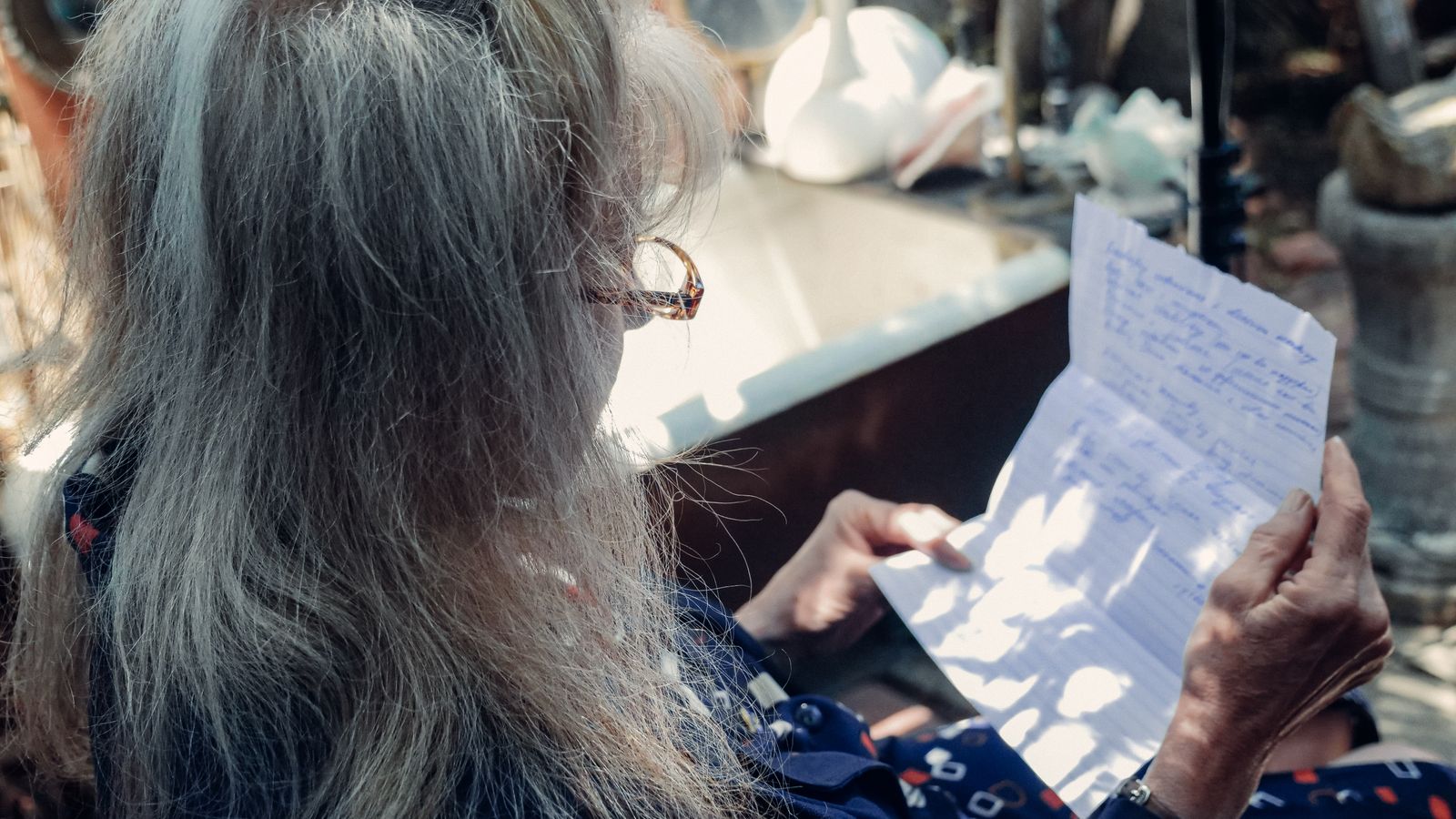
Picture a woman named Dot. She is eighty-four, illustrative but probably familiar. She ran a switchboard for the phone company for thirty-one years, raised three kids, and buried a husband. Ask her for her life story and she will wave you off: "Oh, there's nothing to tell. I just worked."
Then her grandson asks what it was like the night the whole switchboard lit up at once, and forty-five minutes later she is still talking. Who called. What they wanted. The supervisor who cried. The sandwich she never got to eat. Nobody else alive can tell that story, and until somebody asked, Dot didn't think it counted as one.
This series is about why that story is worth keeping, who it belongs to, and what happens when the people around her hear it. This first piece starts with the person telling it, because she is the one who has to believe it matters.
A memoir is not a reward for being famous
We have quietly decided that memoirs are for presidents, athletes and people who survived something dramatic. Everyone else gets an obituary, three paragraphs long, written by a tired relative in an afternoon.
That is a strange way to handle the only first-hand record of a whole life. The details that make a life specific are almost never famous ones: what a week's groceries cost, how a job actually worked, who sat where at Sunday dinner, the song on the radio in the car the day you got engaged. Historians spend careers trying to recover exactly this kind of everyday texture. Families have it sitting in the next room.
Plenty of ordinary people already feel this. Storyworth, which emails a weekly question and binds the answers into a book, reports more than a million printed books, and StoryCorps has recorded over 645,000 people.1 Those are not famous people. They are mostly grandparents answering questions their families finally thought to ask.
Looking back is something older people already do
In 1963 the psychiatrist Robert Butler pushed back on a common idea of the time, that older people who talked about the past were "living in it" or slipping. He argued the opposite. Reviewing your life, he wrote, is a normal and nearly universal process in later life, prompted by the sense that time is shorter.2 People sort through what happened, try to make sense of it, and sometimes make peace with it.
Butler was honest that the process can go either way. It can bring a feeling of resolution. It can also stir up regret. That honesty matters, and we will come back to it in a piece about the hard chapters.
Erik Erikson gave us the other half of the vocabulary. He described the last stage of life as a tension between integrity, accepting the one life you actually lived, and despair. And he described generativity, the urge from midlife onward to leave something for the people who come after you.3 A memoir sits right at the meeting point of those two ideas. Telling it is a way of making sense of your life. Handing it over is a way of leaving something behind.
Looking back isn't living in the past. It is how people make sense of the life they had.
What telling your life does for the teller
Researchers have studied structured looking back, usually called reminiscence or life review, for decades. The biggest summary of that work pooled 128 controlled studies. The largest effect it found was on exactly the thing Erikson described: ego-integrity, the sense that your life hangs together and was worth living. It also found moderate effects on depressive symptoms and on purpose in life, and smaller effects on feeling prepared for death and on feeling socially connected. Most of the effects held up at follow-up.4
A few other findings are worth knowing:
- Structure beats rambling. Life review that walks through a life in order, and tries to make meaning of it, did roughly twice as much for well-being as simply chatting about old times.5
- It helps most when someone is low. In people with depressive symptoms, a well-run Dutch trial found that life review roughly doubled the share who improved at six months, 54 percent against 27.5 percent with usual care.6
- Time matters. A 2026 analysis of 33 trials found that programs lasting eight weeks or more improved life satisfaction more than short ones.7 A life is not told in one sitting, and the benefit seems to come from coming back to it.
- Moving is a natural moment. Barbara Haight's classic study gave structured life review to people newly moved into nursing homes and followed them for up to three years. Those who did it had less depression and hopelessness at one year.8 The move into care is often the last calm stretch to do this well.
What it doesn't do
Here is the part a lot of memoir companies leave out. These effects are real but modest. Many of the studies are small. Nearly all of them used a trained interviewer, not an app. The strongest trial results come from life review offered as treatment to people who were already depressed, and you can't stretch those numbers to cover "everyone who records their stories."9 In dementia, the large Cochrane review found small effects that depended on the setting, with no clear overall gain in quality of life, though also no evidence of harm.10
No one has run a large trial of a do-it-yourself memoir app. Including ours.
So the honest case is not "telling your story will make you healthier." It is something more human than that. Looking back is a thing older people already do. Given a patient listener and some structure, it tends to help people feel their life made sense. And it leaves something behind that no one else can make for them.
Why the ordinary details are the point
If Dot had been a senator, someone else would write her life. Because she ran a switchboard, nobody will, unless she tells it. The plainness of a life is not a reason to skip the memoir. It is the reason the memoir has to come from the person who lived it.
And ordinary lives are not small to the people in them. Your grandmother's first apartment, your father's union job, the year your mother went back to school at forty: to your family these are not trivia. They are the backstory of their own lives. That is the subject of part two of this series.
How to begin this week, with or without us
- Pick one small door. Not "tell me your life." Try "Tell me about the kitchen you grew up in" or "What was your first paycheck for?" Small, concrete questions open bigger ones.
- Go in order, loosely. Childhood, school, first work, love, the family years, later life. Structure helps people find meaning, but it is a path, not a form.
- Come back to it. Fifteen or twenty minutes, once a week, for a season. The research suggests the returning is part of the benefit.
- Record the voice, not just notes. A phone's voice memo app is enough. See our guide to recording a parent's voice.
- Let them skip. Nobody owes anyone every chapter.
Where Porchlight fits
I built Porchlight because the structure is the hard part for most families. On a tablet or phone, a resident taps one big button and hears a question read aloud from a curated life-story sequence. The questions go in a fixed order that starts gentle. They talk, and it records. They can skip anything. The original audio and a written transcript are kept, and the family gets a private page to listen, download and reply. In a senior living community, the same stories become a short briefing for the staff.
That is the whole vision in one line: a life told in the person's own voice, kept by the people who love them, and known by the people who care for them. It starts with someone like Dot deciding her life counts. It does.
Help someone tell the life only they can tell
See how a resident's answers become their own recorded memoir, a family page, and a briefing for the people who care for them.
Explore a live demo Book a demoSources & notes
- Storyworth reports more than one million printed books (company figure, via Wikipedia). StoryCorps reports 645,000+ participants (Wikipedia).
- Butler RN. The life review: an interpretation of reminiscence in the aged. Psychiatry. 1963;26:65-76. PubMed 14017386
- Erikson EH. Childhood and Society (1950) and The Life Cycle Completed (1982). The stages of integrity versus despair, and generativity.
- Pinquart M, Forstmeier S. Effects of reminiscence interventions on psychosocial outcomes: a meta-analysis. Aging & Mental Health. 2012;16(5):541-58. 128 controlled studies. Ego-integrity g = 0.64, depression g = 0.57, purpose in life g = 0.48, death preparation g = 0.40, social integration g = 0.31. PubMed 22304736
- Bohlmeijer E, Roemer M, Cuijpers P, Smit F. The effects of reminiscence on psychological well-being in older adults: a meta-analysis. Aging & Mental Health. 2007;11(3):291-300. Overall d = 0.54; life review d = 1.04 versus simple reminiscence d = 0.40. PubMed 17558580
- Korte J, Majo MC, Bohlmeijer ET, Westerhof GJ, Smit F. Cost-effectiveness of life-review for older adults with moderate depressive symptomatology: a pragmatic randomized controlled trial. J Aging Stud. 2015;34:146-54. Reliable response at six months 54.0% versus 27.5%. PubMed 26162735
- Lin CL, et al. Network meta-analysis of 33 RCTs (2,512 participants) of narrative-based interventions for older adults without dementia. Age and Ageing. 2026;55(3):afag075. Interventions of eight weeks or more improved life satisfaction more than shorter ones. PubMed 41934513
- Haight BK, Michel Y, Hendrix S. Life review: preventing despair in newly relocated nursing home residents. Int J Aging Hum Dev. 1998;47(2):119-42 (PubMed 9836092), and the three-year follow-up, 2000;50(2):151-68 (PubMed 10791613).
- Westerhof GJ, Slatman S. In search of the best evidence for life review therapy to reduce depressive symptoms in older adults: a meta-analysis of randomized controlled trials. Clinical Psychology: Science and Practice. 2019;26(4):e12301. 11 RCTs, 903 participants; d = 0.57 with outliers removed, d = 0.46 at three months. Open-access PDF
- Woods B, O'Philbin L, Farrell EM, Spector AE, Orrell M. Reminiscence therapy for dementia. Cochrane Database of Systematic Reviews. 2018;3:CD001120. 22 RCTs, 1,972 people; small and setting-dependent effects, no evidence of harm to people with dementia. Cochrane summary
Scenarios marked as illustrative are not real named individuals. Porchlight does not fabricate customers, testimonials, or outcome metrics. Podcast quotes are lightly trimmed of filler words; ellipses mark the cuts.