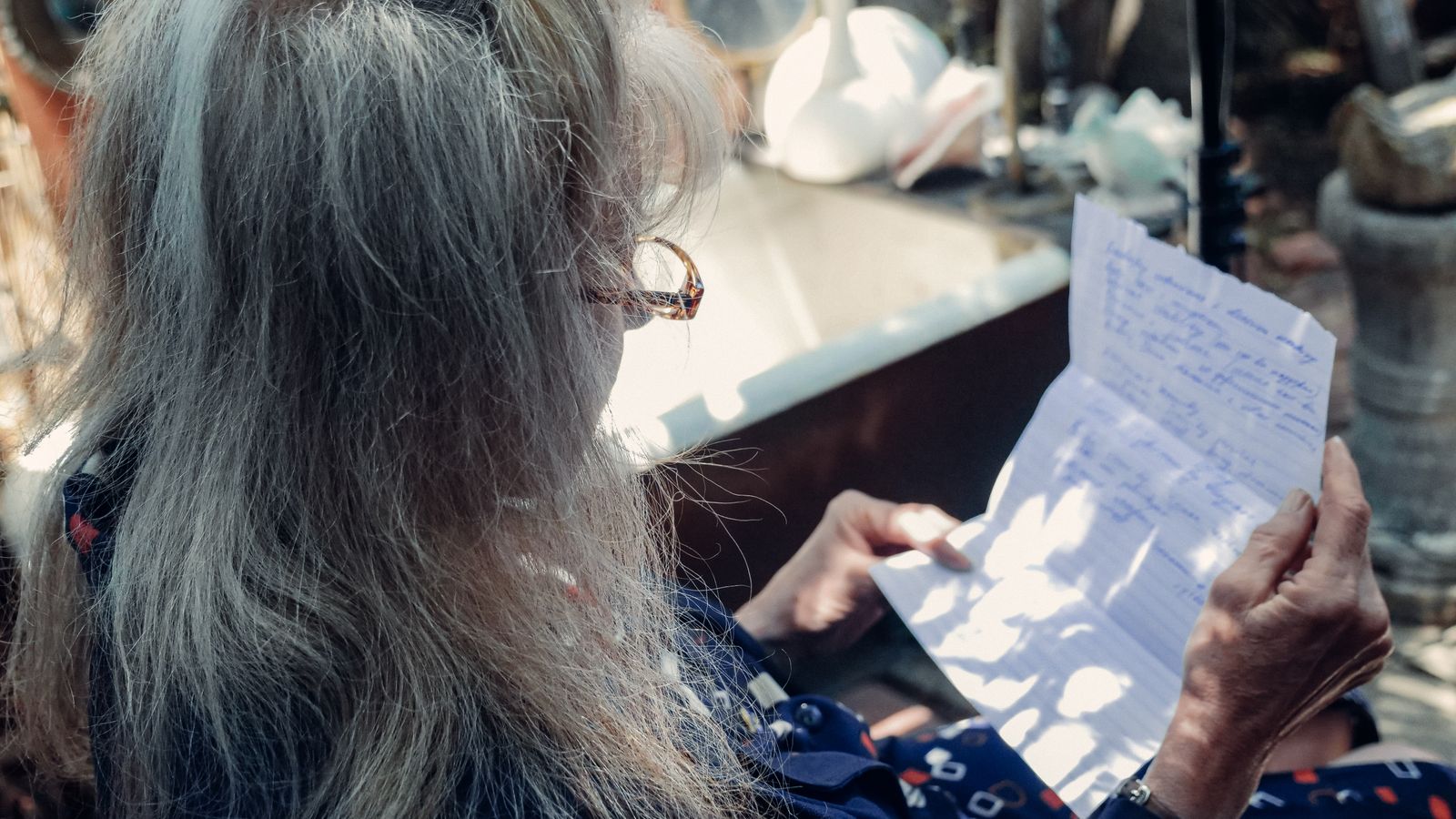
My mother was a hospice nurse for twenty years. When she talked about her work, one phrase came up again and again: we had a really good death. Outside hospice that sounds strange. Inside it, everyone knows what she meant. I tried to put it into words on The Aging Well Podcast:
“a good death would be if you're surrounded by your family, you're able to enjoy yourself as much as possible when you're in final days, you feel useful, you feel safe, you feel loved”
Patrick Donahue, on The Aging Well Podcast9
This article is for the people who make good deaths possible: hospice nurses and aides, social workers, chaplains, spiritual care staff, and volunteers. You already know that the life story matters most near the end. What follows is what the research says about legacy work, where it is strong and where it is weaker than people assume, plus some practical notes on doing it well.
Life review is something the dying already do
In 1963 the psychiatrist Robert Butler described the "life review": a natural process, often sharpened by approaching death, in which people look back over their lives. It can bring a sense of resolution and integration. It can also bring regret and despair.5 Chaplains have worked inside that process forever. Butler's contribution was to name it as normal rather than as "living in the past."
Erik Erikson framed the late-life task as integrity against despair, and the generation-to-generation task as generativity, meaning caring for those who come after. Legacy work sits right where those two meet: making sense of a life and handing something on.
What Dignity Therapy actually found
Harvey Chochinov's Dignity Therapy is the best-studied form of legacy work at the end of life. A trained therapist interviews the patient using a short set of questions about what matters most, what they want remembered, and what they hope for the people they love. The interview is edited into a "generativity document" for the family.
In the first, uncontrolled study, 91% of patients were satisfied, 76% reported a heightened sense of dignity, 68% a greater sense of purpose, and 81% said it had helped or would help their family.1
Then came the randomized trial, with 441 terminally ill patients assigned to Dignity Therapy, client-centered care, or standard palliative care. This result gets left out of a lot of marketing: Dignity Therapy did not significantly reduce distress, depression, anxiety or desire for death. Most patients were not very distressed at the start, which left little room to improve. What it did do was clear. Patients rated it more helpful, said it improved their quality of life and sense of dignity, said it changed how their family saw and appreciated them, and said it would help their family. Those differences were large and highly significant.2
The families agreed. In a survey of 60 bereaved relatives of Dignity Therapy participants, 95% said it had helped the patient, 78% said the document helped them during their grief, and 77% expected it to stay a source of comfort.3 Systematic reviews since then have found consistent benefits for the end-of-life experience and for families, with symptom relief mostly limited to patients who started out distressed.4
Legacy work may not change a depression score. It changes how a family sees the person, and what they get to keep.
Being honest about that makes the case stronger. If you tell a family a recording will lift a patient's mood, you may be overselling. If you tell them it will help them see their father more fully and give them something to hold afterward, you are on solid ground.
Start earlier than you think
The most common regret in legacy work is timing. By the last week, breath is short, energy is low, and clarity comes and goes. A process that would have been a gift in month one can feel like a chore in week twelve.
Life review also seems to work best as a process rather than a single sitting. In one well-known study, newly admitted nursing home residents went through a structured six-to-eight-session life review with a visitor. A year later they had less depression and hopelessness than residents who got friendly visits, and some benefits were still visible three years on among the people who survived.6
Practical implications:
- Offer legacy work at hospice admission, not as a last-days task.
- If the patient lives in a care community, find out whether their story has already been recorded. You may be starting on chapter ten instead of chapter one.
- Several short sessions beat one long one.
- Let the patient choose the focus. For some it is the children. For some it is a faith journey, a craft, a war, or a single regret they want to put down.
Regret, reconciliation, and the right to stop
Butler's warning applies with full force at the end of life. Remembering can open old wounds. Chaplains are often the best-trained people in the building for that moment. A few principles hold across traditions:
- The patient decides what goes in the legacy. What is said in confession or reconciliation does not belong in a document the grandchildren will read, unless the patient wants it there.
- Steer toward meaning, not rumination. "What did that time teach you?" helps more than retelling the injury again.
- Stopping is allowed. An unfinished legacy is still a legacy.
Afterward: the recording as a continuing bond
Grief research moved away from the old "let go and move on" model decades ago. Keeping a continuing bond with someone who has died is now widely understood as normal grief.7 Bereaved people keep voicemails and old texts, and some live with a "fear of second loss": the dread that the phone will die or the account will close and the voice will be gone a second time.
Two cautions. First, there is no good quantitative study showing that listening to a recorded voice improves bereavement outcomes, so do not promise that. Second, the fear of second loss is a real design problem. Families should keep their own copies: downloaded files in two places, and ideally a printed transcript. Paper outlasts platforms.
Demand is not the issue. In a large 2022 YouGov survey, 47% of American adults said they regret not recording a conversation with someone close who has died.8 Hospice teams meet those families every day, often a few months too late.
Where Porchlight fits
Porchlight is not a hospice product and not a replacement for Dignity Therapy or a chaplain's presence. It is a way for older adults in care communities to record their stories in their own voice, early and in small pieces, so that by the time hospice arrives, there is something there.
Here is what that means in practice:
- The resident records with one button. Questions are read aloud in a fixed, gentle order. Any question can be skipped. For residents with less energy or later-stage dementia there is a slower setting with simple-choice questions, and it stops warmly after two unanswered questions.
- Families keep the originals. On a private family page they can listen, read transcripts, download the audio, and reply with voice notes the resident can play. An optional printed memory book gives the paper copy.
- The care team gets a briefing. A short summary of who the person is, with conversation starters, helps every new face, including a hospice aide on a first visit, start from the person rather than the diagnosis.
- Others can add stories. When a resident can no longer tell their own, family and staff can add stories on their behalf, marked as such.
What it does not do: it does not detect distress, it is not therapy, and the AI's job is limited to transcribing and tidying what was said. The original recording is always kept.
Something to do this week
At your next admission, add one question to your intake: "Is there a story you want your family to have in your own voice?" Write down the answer. If it is yes, get a phone recording that week. Do not wait for a better moment.
Start the story before the last weeks
See how a resident's stories, recorded in their own voice, become something the family can listen to and keep.
See the family demo Talk with usSources & notes
- Chochinov HM, Hack T, Hassard T, et al. Dignity therapy: a novel psychotherapeutic intervention for patients near the end of life. J Clin Oncol 2005;23(24):5520-5525. Uncontrolled. PubMed 16110012
- Chochinov HM, Kristjanson LJ, Breitbart W, et al. Effect of dignity therapy on distress and end-of-life experience in terminally ill patients: a randomised controlled trial. Lancet Oncology 2011;12(8):753-762. 441 randomized. PubMed 21741309
- McClement S, Chochinov HM, Hack T, et al. Dignity therapy: family member perspectives. J Palliat Med 2007;10(5):1076-1082. 60 bereaved family members. PubMed 17985964
- Martínez M, Arantzamendi M, Belar A, et al. 'Dignity therapy', a promising intervention in palliative care: a comprehensive systematic literature review. Palliative Medicine 2017;31(6):492-509 (PubMed 27566756); Grijó L, Tojal C, Rego F. Effects of dignity therapy on palliative patients' family members: a systematic review. Palliat Support Care 2021;19(5):605-614 (PubMed 33818358).
- Butler RN. The life review: an interpretation of reminiscence in the aged. Psychiatry 1963;26:65-76. PubMed 14017386
- Haight BK, Michel Y, Hendrix S. Life review: preventing despair in newly relocated nursing home residents short- and long-term effects. Int J Aging Hum Dev 1998;47(2):119-142 (PubMed 9836092), and the three-year follow-up, 2000;50(2):151-168 (PubMed 10791613).
- Klass D, Silverman PR, Nickman SL (eds). Continuing Bonds: New Understandings of Grief. Taylor & Francis, 1996. And Bassett DJ, on the bereaved and saved digital messages, including the "fear of second loss": The Conversation. Qualitative; no study shows a recorded voice improves bereavement outcomes.
- YouGov, "Nearly half of Americans regret not preserving memories of loved ones who have died," survey of 6,090 US adults, May 31 to June 1, 2022. yougov.com
- The Aging Well Podcast, Episode 499, "The Stories That Make Us: Why Being Known Matters as We Age," with Dr. Jeff Armstrong (October 2026). Timestamps link to the moment quoted. Episode notes.
Scenarios marked as illustrative are not real named individuals. Porchlight does not fabricate customers, testimonials, or outcome metrics. Podcast quotes are lightly trimmed of filler words; ellipses mark the cuts.