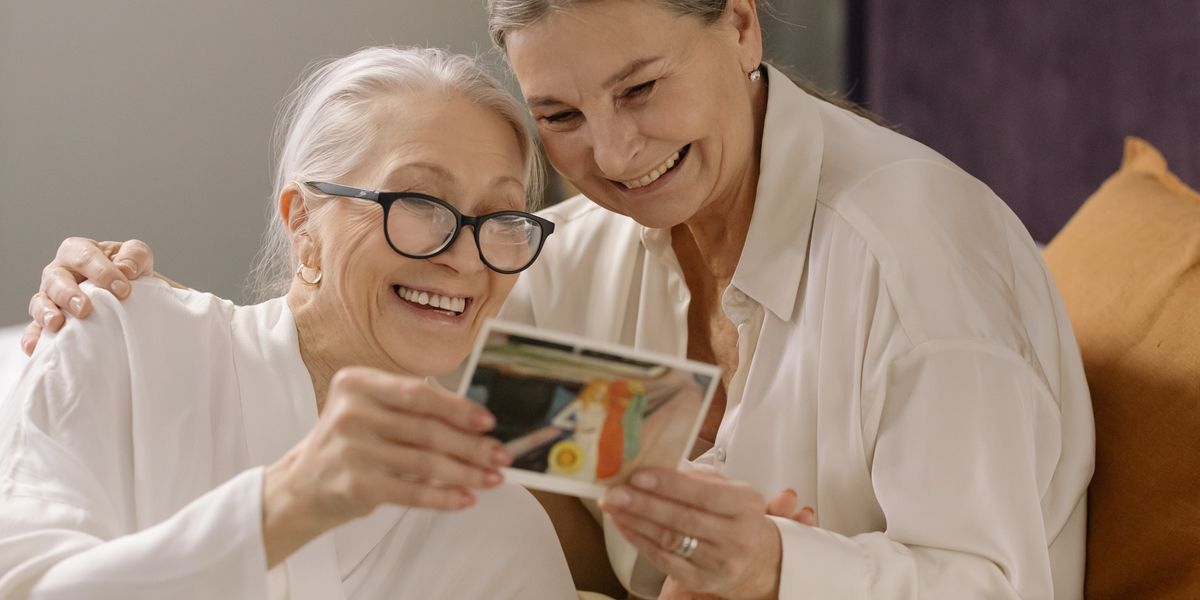
Picture a man named Walt who shows up at ten every morning with two coffees and the sports page. His wife of fifty-eight years lives in the memory care wing now. Some days she knows his name and some days she knows only that he is someone safe. Every day, he tells her the same story about the night they met at a church dance in 1965, when she stepped on his foot and blamed him for it. Every day, when he gets to that part, she laughs.
Walt is illustrative. If you are a husband or wife whose spouse now lives down a hallway instead of across the breakfast table, you probably know the routine he has built: same chair, same story, same laugh. This article is about protecting that routine and about protecting you.
You are carrying more than people see
Adult children often get the attention after a placement. Spouses often carry more. In the JAMA study that followed family caregivers of people with dementia through a nursing home placement, caregivers' depression and anxiety did not fall after the move. Spouses fared worst, and about half of them visited every day.1
That number explains a lot. You are not off duty. You moved your marriage to a new address, and you are now commuting to it.
When I talked about family caregiving on The Aging Well Podcast, I said something I want every spouse to hear:
“no matter how much you love that person, the caregiver still has their limits in terms of what they can do.”
Patrick Donahue, on The Aging Well Podcast6
Taking a day off is not abandonment. If you can only come four days a week and stay rested, that will usually do more good than seven days of running on empty.
Half of a shared story
Most life-story advice is written for children interviewing a parent. A marriage is different. You were there. For fifty years or so, you two have been writing the same book from opposite sides of the table. You know the version she tells and the version you tell, and the fact that they do not quite match is part of the fun.
That makes you the most important source of one specific thing: the person your spouse was with you. The care team cannot get that from a chart, and your children only saw the part after they were born.
The staff know the patient. You know the person who stepped on your foot at the dance.
Telling it together, gently
If your spouse can still tell stories, tell them together. A few things help:
- Lead with the story, not a quiz. "Remember where we met?" can feel like a test. "I was thinking about that church dance, when you stepped on my foot" lets them join in without having to remember anything first.
- Let their version win. If she says it was 1966, it was 1966. Correcting the details costs you the warmth of the moment.
- Repeat the good ones. Repetition is fine. A familiar story told the familiar way can be a comfort for both of you.
- Keep it light and optional. One large trial put people with dementia and their family carers into weekly reminiscence groups together. It found no benefit for the people with dementia, and the carers who took part ended up more anxious.3 Shared remembering should feel like a visit, not homework.
If you record a story together, you keep both of your voices, which your grandchildren will treasure. In Porchlight, staff can mark that a partner joined the session, so your spouse's own words stay clearly separate from yours in what the care team reads.
When words get harder
As dementia advances, some people can no longer tell their stories at all. That does not mean the stories are gone. It means someone has to carry them.
Porchlight lets family and staff add stories on behalf of someone who cannot tell them anymore, marked as told by someone else. Those stories help build the short briefing that the care team sees. So when your spouse can no longer explain that she taught third grade for thirty years, or that she hated being called "dear," you can. The new aide still finds out.
For residents who can still answer some questions, there is a gentler setting. The pace slows, questions come as simple choices ("Did you like summer or winter better?"), and the session closes warmly if two questions in a row go unanswered, with a note left for staff.
Give the care team the person you married
Nursing homes are required by federal rule to assess each resident's "life history and preferences."5 What ends up on the form is often one line. You can make it real. Tell the nurse and the aides the handful of things that matter most: the name she likes, the song that calms her, the subject that upsets her, the way she likes her hair done.
Research on a family and staff partnership program in dementia units found that when families and staff were trained to communicate with each other, spouses became more involved in care, staff reported less conflict with families and less depression, and residents' behavioral symptoms decreased.2 That program was people talking, not software. It is still a good reason to keep showing up at the nurses' station with useful information and not only worries.
On sick days, a voice note
There will be days you cannot make it in: a cold, a doctor's appointment, a snowstorm. On those days a short recorded message can carry your voice down the hall. With Porchlight, family members can reply to stories with voice notes that the resident can play.
Be realistic about this. Researchers have studied playing family recordings to people with dementia, under the name "simulated presence," and the evidence is very weak. Some people are comforted. A few get more upset and go looking for the person they just heard.4 Let staff decide when to play a message and when to wait, and ask them to tell you how it went.
One more thing. Some companies now offer to clone a loved one's voice with AI. We do not. When the topic came up on the podcast, I said:
“some people do want to voice clone someone who's passed on in order to get them a birthday wish or something. We are not doing anything like that.”
Patrick Donahue, on The Aging Well Podcast
Every voice note in Porchlight is a real person speaking. In a marriage, that is the whole point.
Your own story counts too
Spouses are so busy carrying their partner's story that they forget they have one. Your children and grandchildren will want your half as much as hers: how you saw the church dance, what you were scared of when the first baby came, what fifty-eight years of marriage taught you that no one could have told you at twenty-four.
If you are still living at home, record a few of your own stories with a phone. Our guide to recording a voice with just a phone works just as well for you. If you live in the same community as your spouse, you can be a resident with a story of your own, and not only a visitor. Some of the best recordings a family ends up with are the ones where both voices tell the same memory a little differently, and the grandchildren get to decide who was right.
Telling your own story is not a betrayal of the caregiving. Often it is the only hour of the week that is about you.
Something to do this week
Write down three stories only the two of you know. The proposal. The worst vacation. The time the car broke down. Tell one of them to her this week, the same way you always tell it. Then tell it to the aide who works her morning shift. You may notice that the aide starts telling it back to her.
Keep both of your voices
See how stories, including ones you tell together or on their behalf, become a private family page and a short briefing for the care team.
See the family demo Explore a live demoSources & notes
- Schulz R, Belle SH, Czaja SJ, et al. Long-term care placement of dementia patients and caregiver health and well-being. JAMA 2004;292(8):961-967. PubMed 15328328
- Robison J, Curry L, Gruman C, et al. Partners in Caregiving in a Special Care Environment: cooperative communication between staff and families on dementia units. The Gerontologist 2007;47(4):504-515. PubMed 17766671
- Woods RT, Orrell M, Bruce E, et al. REMCARE: pragmatic multi-centre randomised trial of reminiscence groups for people with dementia and their family carers. PLoS One 2016;11(4):e0152843 (PubMed 27093052); full report in Health Technology Assessment 2012;16(48).
- Abraha I, et al. Simulated presence therapy for dementia. Cochrane Database of Systematic Reviews 2017 (updated 2020). Three trials, 144 participants, very low certainty evidence. PubMed 28418586; and Camberg L, et al. Evaluation of Simulated Presence. J Am Geriatr Soc 1999;47(4):446-452 (PubMed 10203120).
- 42 CFR 483.20(b)(1), Resident assessment: a facility must assess "a resident's needs, strengths, goals, life history and preferences." This applies to federally certified nursing homes; assisted living is regulated by each state. eCFR
- The Aging Well Podcast, Episode 499, "The Stories That Make Us: Why Being Known Matters as We Age," with Dr. Jeff Armstrong (October 2026). Timestamps link to the moment quoted. Episode notes.
Scenarios marked as illustrative are not real named individuals. Porchlight does not fabricate customers, testimonials, or outcome metrics. Podcast quotes are lightly trimmed of filler words; ellipses mark the cuts.