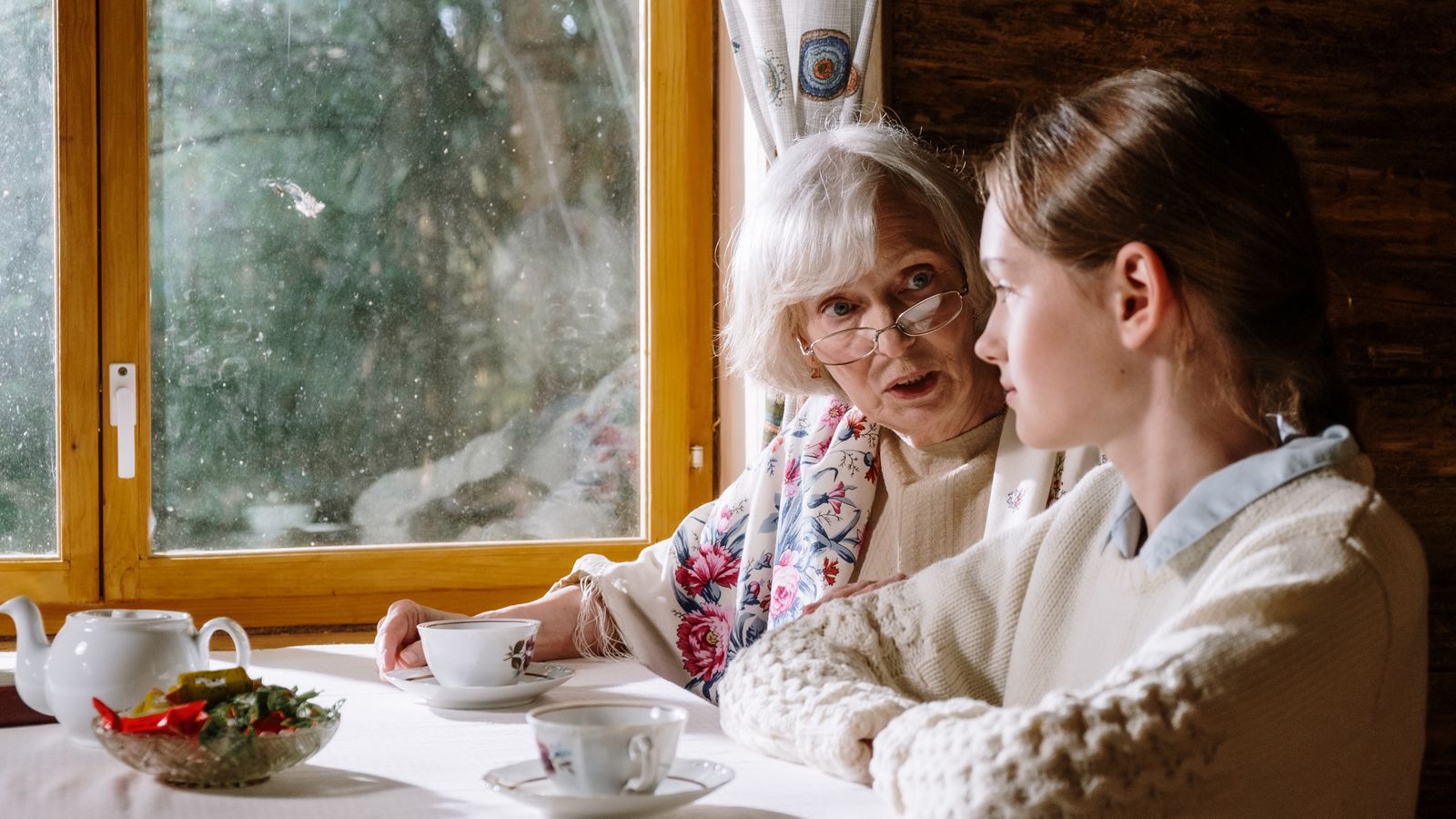
Picture a nursing student on her first volunteer visit. Call her Priya. She has a clipboard of questions from her gerontology class, and the man she has been paired with, a retired welder, answers each one in three words. Twenty minutes in, she gives up on the clipboard and asks why his hands are scarred. He talks for an hour.
That illustration holds most of what this guide says. If you are a friendly visitor, a student in a service-learning program, a member of a faith group, or anyone who gives time to older adults, you are in a rare position: you have time to listen, and staff usually do not. Here is how to make that time count, and how to keep it safe.
Why your visit matters
Aides in senior living often care for a dozen or more people in a shift. They want to sit and hear stories, and they rarely can. You can.
Reminiscence, meaning gently prompting someone to talk about their past, has been studied for decades. The best summary of the research on people with dementia, a Cochrane review of 22 trials, found modest and mixed benefits overall. The clearest signals came in care homes and in individual sessions rather than groups, and the review found no evidence that reminiscence harmed the people with dementia who took part.1 One-to-one conversation is exactly what a volunteer can offer.
Be clear with yourself about what you are there to do. You are not doing therapy. You are being a good listener, which is rarer than it should be.
Questions that open people up
- "Tell me about..." beats "Do you remember..." The second can feel like a memory test, and many older adults worry about their memory. The first is an invitation.
- Small and concrete beats big and abstract. "What was your childhood like?" gets "Fine." "What did your kitchen smell like on Sunday?" gets a story.
- Notice the room. Photos, a model ship, a framed certificate, the scarred hands. Ask about what you see.
- Follow tangents. If they drift from school to a dog named Pepper, go with Pepper.
- Trade a little. Tell them something about your own life. People open up to people, not interviewers.
Our reminiscence questions for seniors and printable question cards are good starting points. Use them as a warm-up, not a script.
The silence you should leave alone
The most common volunteer mistake is filling a pause. When an older person goes quiet after a question, they are often searching for a memory or deciding how much to say. Count to ten in your head before you speak. Many of the best answers come at second eight.
The second most common mistake is correcting. If the dates are wrong or the story changed since last week, let it go. You are not checking facts. You are honoring the person telling it.
Count to ten before you fill a silence. The good part of the answer often comes at second eight.
When a story turns hard
Not every memory is a happy one, and not all remembering is good for people. Researchers have found that going over old grievances again and again, which they call "bitterness revival," goes with more depression, while remembering that helps a person make sense of their life goes with better well-being.2 Robert Butler, who first described the "life review" in 1963, warned that it can bring up regret and despair as well as peace.8
Combat veterans are a special case. For some, late-life losses bring wartime memories back. That can lead to growth when there is good support, or to renewed distress.3 Do not ask a veteran about combat. If they bring it up, listen without probing.
If someone becomes upset:
- Slow down. Acknowledge what they said: "That sounds like it was really hard."
- Offer a choice: "Would you like to keep talking about it, or talk about something else?"
- Never push for details.
- Stay until they are settled, and tell a staff member afterward. Staff need to know, and you should not carry it alone.
Whose story it is
Life-story researchers keep coming back to one warning. Private memories surface in conversation that the person would never want written down or passed along.4 Staff in one review said the hard moments were when sensitive information came out unasked, and when it was unclear whose story was being told: the resident's, the family's, or the professional's.5 In a pilot of life story books in 16 nursing homes, residents became less willing to share their finished books with others afterward.6
So, some ground rules:
- What you hear in the room stays in the room unless the resident says otherwise and the community's rules allow it.
- No photos, recordings, or social posts without explicit permission from the resident and the community.
- If you are writing something up for a class, change names and details, and ask first.
- If you hear something that suggests the person is being harmed, tell staff. That is the one exception to keeping it to yourself.
Pass along one good detail
A visit can help after you leave. Aides turn over quickly in senior living, and a resident's life history often sits in a binder nobody reads on a busy shift. You may learn in one afternoon what the staff have not had time to find out in a month: that she was a church organist, that he still roots for the Brooklyn Dodgers, that she hates being called "sweetie."
With the resident's permission, pass along one good detail to the activity director or the aide on shift. Pick something that helps them connect, not something private: a nickname, a favorite song, a hobby, something that reliably gets a smile. Research on life stories in care settings keeps finding that what staff know about a person shapes how they see that person, and how warmly they treat them. Read more in why your care team should know your story.
If you are visiting the same person every week, you can become the person who knows them best. That is worth sharing with the people who care for them on the other six days.
If the community uses Porchlight
Some communities use Porchlight so residents can record their stories in their own voice. The resident taps one big button on a tablet or phone, hears a question read aloud, and talks. The questions come in a fixed, gentle order, and any question can be skipped. The recordings go to the resident's family and become a short briefing for the care team.
A volunteer can be a great help here, simply by sitting with a resident while they record: setting up the tablet, being an encouraging face, and letting them do the talking. A few notes:
- Let the resident answer. If you join the conversation, tell staff, so they can mark that a partner was present and keep the resident's own words separate.
- Porchlight does not detect distress. You are the person in the room. If a question lands badly, help them skip it and tell staff.
- Follow the community's consent rules. Recording happens only with the resident's agreement.
The bigger picture
More than 645,000 people have recorded a conversation with StoryCorps since 2003.7 People want to be asked about their lives. In senior living, the question is usually whether anyone has the time to ask. As a volunteer, you do, and that is why your visit matters.
Something to do on your next visit
Leave the clipboard in the car. Find one object in the room and ask about it. Count to ten before you speak again. Then come back next week and ask a follow-up about what you heard. Being remembered is a gift to them, and to you.
Volunteering at a community that uses Porchlight?
Sitting with a resident while they record is a wonderful way to help. See what the resident screen looks like before your first visit.
Explore a live demo Get question ideasSources & notes
- Woods B, O'Philbin L, Farrell EM, Spector AE, Orrell M. Reminiscence therapy for dementia. Cochrane Database of Systematic Reviews 2018;3:CD001120. 22 trials, 1,972 people. Cochrane summary
- O'Rourke N, Cappeliez P, Claxton A. Functions of reminiscence and the psychological well-being of young-old and older adults over time. Aging & Mental Health 2011;15(2):272-281 (PubMed 21140308); Korte J, Bohlmeijer ET, Westerhof GJ, et al. Reminiscence and adaptation to critical life events in older adults with mild to moderate depressive symptoms. Aging & Mental Health 2011;15(5):638-646 (PubMed 21815856).
- Davison EH, Kaiser AP, Spiro A, et al. From late-onset stress symptomatology to later-adulthood trauma reengagement in aging combat veterans: taking a broader view. The Gerontologist 2016;56(1):14-21. PubMed 26553735
- McKeown J, Ryan T, Ingleton C, Clarke A. "You have to be mindful of whose story it is": the challenges of undertaking life story work with people with dementia and their family carers. Dementia 2015;14(2):238-256. doi:10.1177/1471301213495864
- Grøndahl VA, Persenius M, Bååth C, Helgesen AK. The use of life stories and its influence on persons with dementia, their relatives and staff: a systematic mixed studies review. BMC Nursing 2017;16:28. doi:10.1186/s12912-017-0223-5
- Ejaz FK, Rose M, Polk M. Evaluating nursing home resident and staff experiences with a life story program. A pilot in 16 nursing homes. J Appl Gerontol 2022;41(1):124-133. No control group. doi:10.1177/07334648211008682
- StoryCorps, founded 2003; more than 645,000 participants, with interviews archived at the Library of Congress American Folklife Center. Overview. No outcome studies of participants were found.
- Butler RN. The life review: an interpretation of reminiscence in the aged. Psychiatry 1963;26:65-76. PubMed 14017386
Scenarios marked as illustrative are not real named individuals. Porchlight does not fabricate customers, testimonials, or outcome metrics. Podcast quotes are lightly trimmed of filler words; ellipses mark the cuts.